
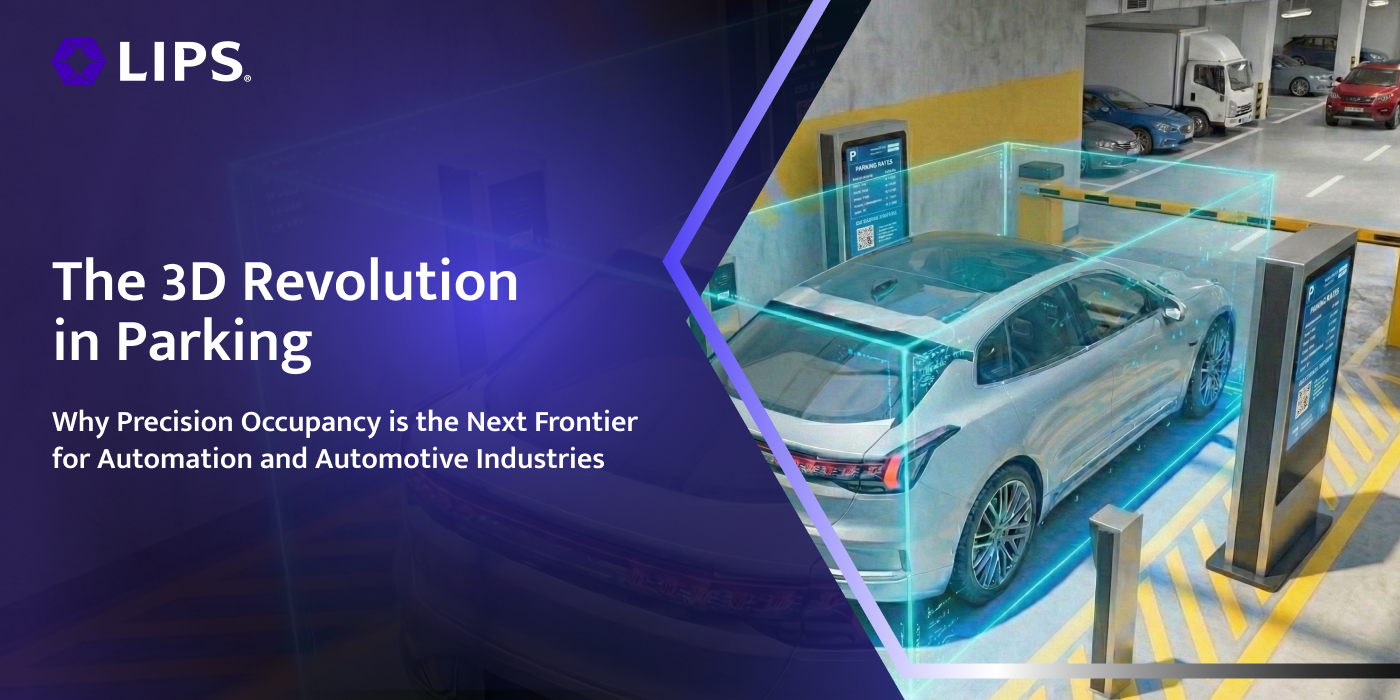
As Smart Cities and industrial environments continue to evolve, the way we manage physical space has become a defining factor in operational efficiency, safety, and profitability. Parking occupancy detection infrastructure, once treated as a static asset, is now a dynamic data source that directly influences mobility, user experience, and automation readiness.
However, for over a decade, the industry has struggled with a persistent challenge. While the technology is mature and sensors are cheap, parking operators still face consistent accuracy issues. For years, vehicle occupancy tracking relied on 2D cameras and ultrasonic sensors that delivered acceptable results under ideal conditions. However, as infrastructure becomes more complex, “good enough” data is no longer sufficient.
The issue is not insufficient coverage or outdated equipment. It is that conventional systems measure the wrong thing. They attempt to solve a physical measurement problem using visual classification.
To address these limitations, LIPS has developed a next-generation parking occupancy detection approach that is fundamentally built on 3D AI vision. By combining ruggedized 3D depth sensing at the edge with advanced spatial analytics in the cloud, LIPS is redefining how parking assets are measured, managed, and monetized.
The Core Philosophy: Why “Visual Proxies” Fail in Real-World Parking Detection
At first glance, the problem statement seems binary: a space is either occupied or vacant. Yet, a 3% error rate in occupancy state introduces compounding uncertainty across dependent systems.
Why does this happen? Because 2D cameras measure appearance, not physical state. Common 2D vision systems rely heavily on color, texture, and contrast, which are visual proxies that break under environmental variability. Common issues include:
- Shadows mistaken as vehicles
- Rain, glare, and low-light conditions
- Partial vehicle visibility
- Different vehicle sizes and shapes
- Camera angle and height limitations
- Outdoor environmental variability
Shadows from structures are mistaken for vehicles because they have high contrast. Wet pavement reflects light differently than dry pavement, while a shopping cart or trash bin may have visual properties similar to a small vehicle. In these cases, the system is not measuring whether a space contains a vehicle; it is inferring occupancy from unstable visual patterns.
As a result, even a small detection error rate can compound into significant operational and revenue losses over time. This is why a shift to 3D vision is necessary. It is a shift from visual classification to physical measurement.
A Scenario-Based View: 3D depth Cameras Measure Physical Reality
Imagine a typical outdoor parking area with multiple spaces and continuous vehicle turnover throughout the day.
Instead of relying solely on flat images, a 3D depth camera captures depth information, allowing the system to understand the physical structure of the scene, such ashow far objects are from the camera, their height, and their spatial boundaries.
This depth-aware approach answer a simple but crucial question with high reliability:
Is there a physical object occupying this parking space(volume of space)?
Unlike 2D systems, depth measurement is unaffected by lighting conditions, shadows, or surface color. A vehicle occupies the same physical volume whether the sun is shining or the lot is dark. A shadow does not register as a vehicle because it does not occupy vertical space.
Why 3D Depth Cameras Change the Game for Smart Parking Technology
Compared to conventional RGB cameras, 3D cameras provide both image and depth data, making them far more resilient to environmental variations.
Key advantages include:
- Depth-based detection unaffected by shadows or color changes
- Accurate differentiation between vehicles and ground surfaces
- Consistent performance in rain, strong sunlight, or low light
- Improved detection even with partial occlusions
- For parking occupancy detection, depth information is especially valuable because a vehicle is defined by volume, not just appearance.
👉 See It in Action – Request a Quick Demo
From Depth Data to Intelligence: Measure Master SDK for Automated Parking Management
Capturing depth data is only the first step. The real value comes from how that data is processed.
Using LIPS Measure Master SDK, parking occupancy detection is implemented through a structured, rule-based 3D measurement approach rather than fragile visual heuristics.
How the Measurement-Based Occupancy Detection Algorithm Works
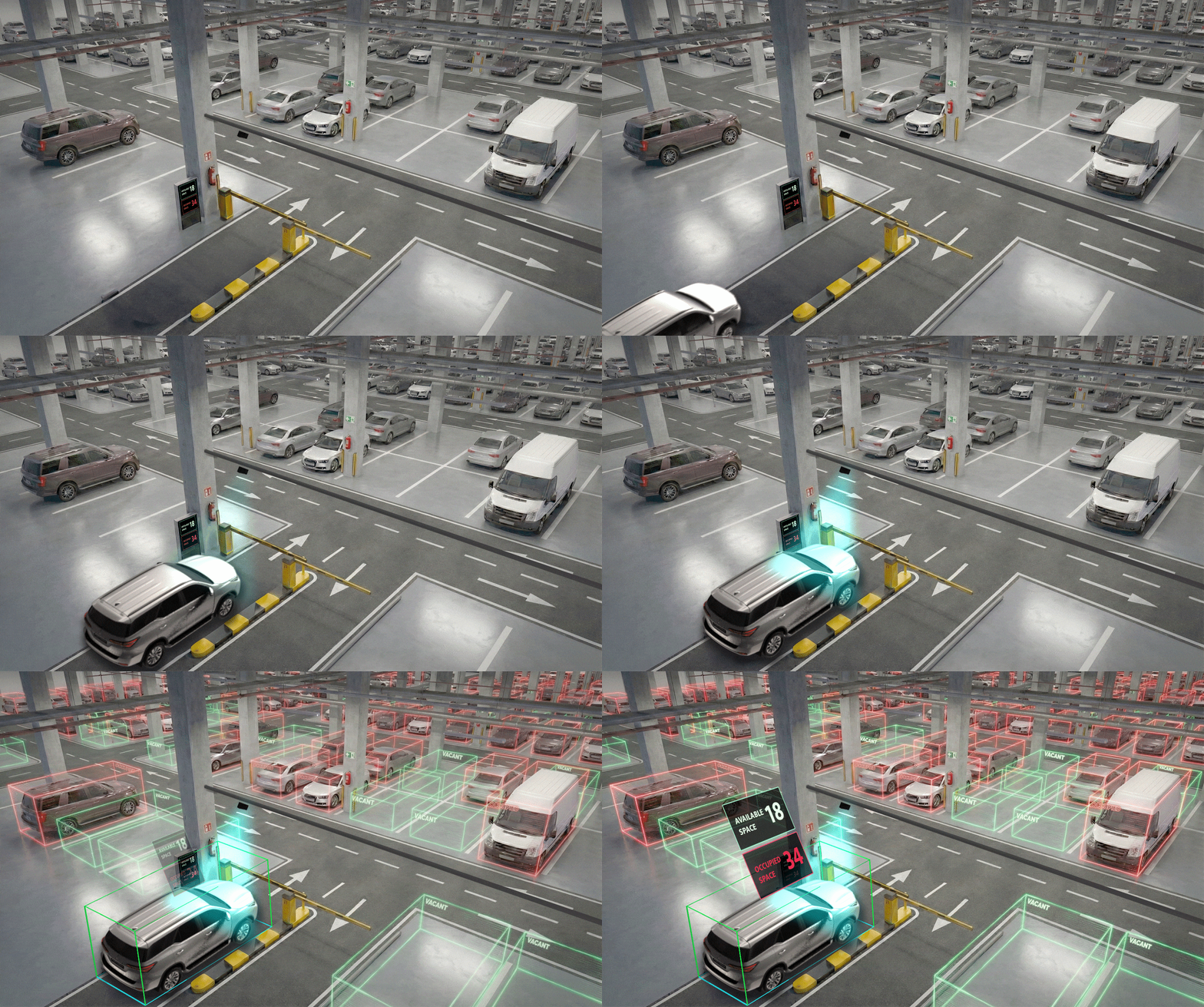
- Define Detection Zones
Each parking space is defined as a 3D detection zone based on its physical boundaries. - Depth Measurement & Height Analysis
The system continuously measures height and volume changes within each zone. - Occupancy Logic
The detection logic is deterministic. If the measured depth exceeds a defined threshold for a stable duration, the space is classified as occupied.
If not, it is classified as vacant. - Confidence Handling
Temporary obstructions or noise are filtered out, reducing false positives and false negatives.
This approach focuses on physical reality rather than visual guesswork, which is essential for reliable smart parking systems.
 Scalable Architecture for Real-World Deployment
The solution is designed with scalability and system integration in mind:
- 3D cameras installed on-site capture RGB + depth data
- Centralized server-based processing performs the occupancy analysis
- Structured outputs (CSV, APIs, dashboards) integrate seamlessly with Parking management platforms, Billing systems, Mobility apps and Smart city infrastructure
Why This Matters: Ground-Truth Data for the Future of Mobility
Accurate parking occupancy data is no longer just about finding a spot. The data directly impacts:
- Revenue assurance
- Traffic flow optimization
- Driver experience
- Smart city planning
- Autonomous and connected vehicle ecosystems
For three groups in particular, this shift to measurement-based detection is critical:
- Parking Operators: Eliminating billing errors and the operational resources spent resolving disputes over false automated charges.
- Mobility Platforms: Rideshare staging and EV charging management require high-confidence data. Systems that depend on ground-truth cannot tolerate persistent error rates.
- Automotive Companies: As we build autonomous parking features, visual inference is not sufficient when safety and liability are involved. The industry needs measurement infrastructure it can depend on.
You can easily adapt the solution for:
- Outdoor parking lots
- Indoor parking facilities
- Car wash occupancy tracking
- Temporary or pop-up parking areas
As vehicles become more connected and cities push toward intelligent transportation systems, reliable ground-truth data becomes non-negotiable.
3D vision–based occupancy detection provides that reliability.
When to Deploy Depth-Based Parking Detection
We believe in transparency regarding deployment. Depth-based occupancy detection solves a specific measurement problem is not universally optimal, but it is the right choice when the cost of inaccuracy exceeds the cost of infrastructure.
This solution is especially ideal when:
- Revenue assurance is critical.
- Environmental conditions (outdoor lighting, weather) degrade standard 2D vision.
- Scale justifies the investment in centralized processing and consistent detection logic.
Key Benefits of LIPS 3D Parking Occupancy Solution at a Glance
- High accuracy in complex outdoor environments
- Reduced dependency on lighting and weather conditions
- Flexible deployment across different parking layouts
- Clear integration path for system integrators
- Long-term scalability for large parking networks
Looking Ahead: The Future of Smart Parking Technology
Parking is no longer just about finding an empty space-it is about data-driven mobility. This is not just an upgrade; it is a category change.
With 3D vision and intelligent measurement-based algorithms, parking systems can move beyond estimation and toward precision, automation, and trust.
For automotive companies, system integrators, and smart infrastructure providers, adopting depth-based occupancy detection is the only practical step toward building the reliable ground-truth layer required for the next generation of automation.
Ready to Eliminate Detection Errors?
If billing accuracy or automation reliability matters to your operation, let’s discuss how LIPS can help.
- Email: [email protected]
- Talk to Solutions Team: (+886) 2-8791-6998
FAQ: LIPS 3D Parking Occupancy Detection Solution
Q1: How does 3D depth sensing differ from traditional 2D camera parking detection?
2D cameras rely on visual patterns like color, contrast, and texture to infer whether a parking space is occupied, making them vulnerable to shadows, lighting changes, and weather conditions. 3D depth cameras measure the actual physical volume and distance of objects in a space, providing ground-truth occupancy data regardless of environmental conditions. This shift from visual classification to physical measurement eliminates common false positives caused by shadows or wet pavement reflections.
Q2: Can 3D parking occupancy detection work for both indoor and outdoor parking facilities?
Yes. Depth-based parking detection is designed to perform reliably in both indoor and outdoor environments. Unlike 2D vision systems that struggle with variable lighting, 3D depth sensing maintains consistent accuracy whether in covered parking structures, open-air lots, or facilities with mixed lighting conditions. The system measures physical vehicle presence rather than relying on visual appearance, making it ideal for diverse deployment scenarios including EV charging stations, car washes, and temporary parking areas.
Q3: Is 3D parking occupancy detection compatible with existing smart city and parking management systems?
Absolutely. LIPS 3D parking occupancy solution is built with integration in mind. The system outputs structured data through standard formats (CSV, APIs, dashboards) that seamlessly connect with existing parking management platforms, billing systems, mobility apps, and smart city infrastructure. This makes it straightforward for system integrators to upgrade from legacy 2D camera systems without overhauling their entire technology stack, while gaining the accuracy benefits needed for autonomous vehicles and EV charging management.