
Autonomous Mobile Robots (AMRs) are no longer experimental technology. They are rapidly becoming a foundational layer of modern warehouses, factories, and logistics centers—driven by labor shortages, rising safety expectations, and the demand for 24/7 operational efficiency in factory automation.
Yet despite growing investment, a large number of AMR projects never move beyond pilot deployments. Robots that perform well in controlled demos often struggle in real-world environments.
A critical reason is now widely acknowledged across the industry:
Over 60% of AMR deployment failures stem from poor perception and navigation accuracy.
At the heart of these failures is not the robot chassis, motors, or controllers—but the perception stack: how the autonomous mobile robots sees, understands, and navigates their environment.
As warehouses become more dynamic, crowded, and human-centric, legacy perception approaches-especially 2D LiDAR-are increasingly becoming a bottleneck rather than an enabler for effective AMR deployment.
At LIPS, we designed LIPSAMR™ to address this exact problem: delivering a LiDAR-free, vision-based perception platform that enables safer, smarter, and more scalable AMR deployments.
Below, we break down the top five engineering and deployment challenges in AMRs today and explain how LIPSAMR™ 3D stereo vision + AI + VSLAM+ Navigation architecture solves them at the root.
Who This Blog Is For
This deep dive is designed for:
- AMR OEMs building next-generation robots
- System integrators aiming to reduce deployment risk
- R&D teams developing custom navigation stacks
- Warehouse and factory operators evaluating alternatives to LiDAR-based AMRs
If you are designing, deploying, or selecting AMRs-and facing scaling or reliability challenges-this article is for you.
Challenge 1: Planar Blindness in 2D Obstacle Detection
The Problem
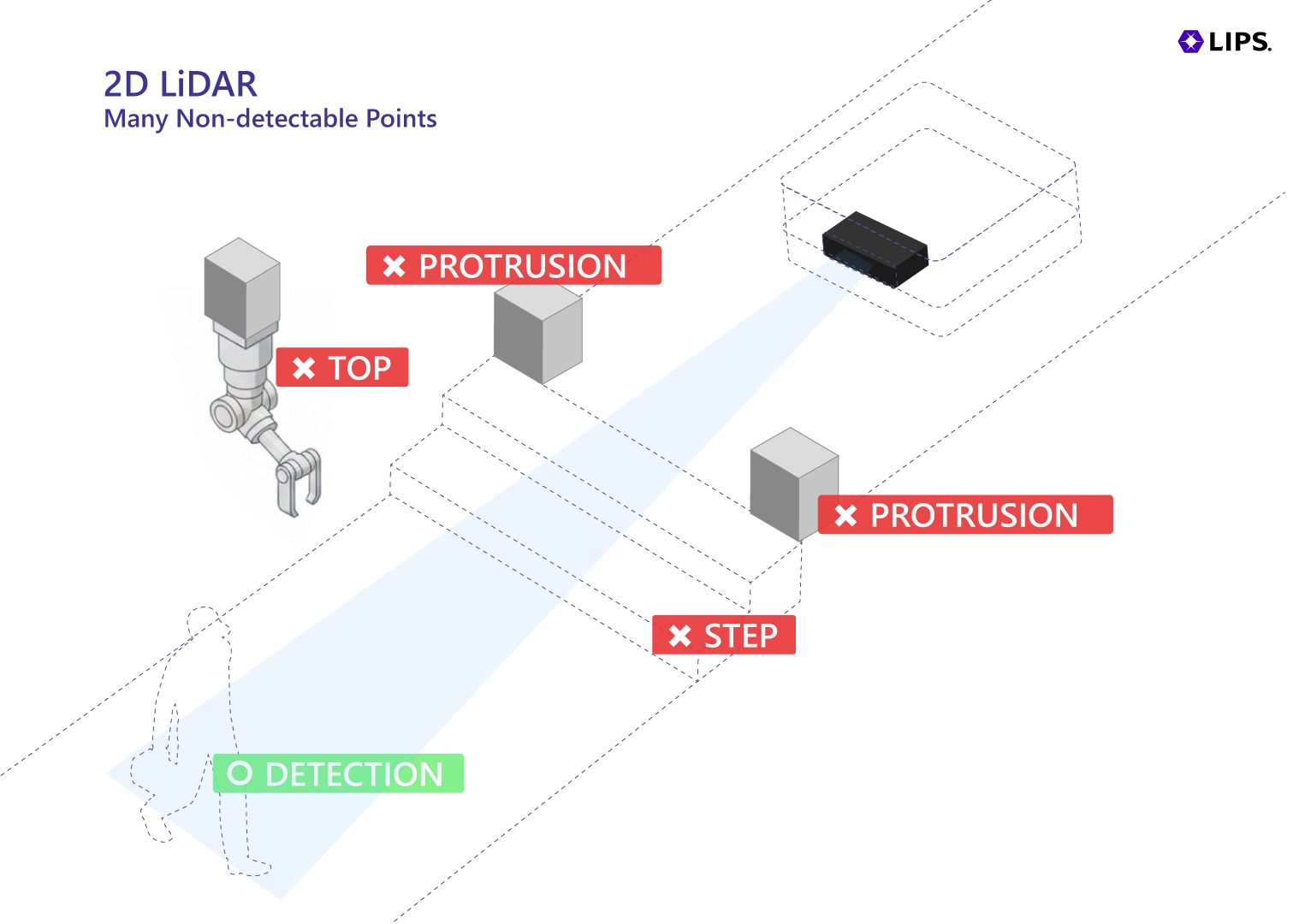
Most traditional AMRs rely on 2D LiDAR, which scans a single horizontal plane-typically 15-30 cm above the ground.
Typical real-world symptoms of AMR perception failures include:
- Collisions with pallet forks, cantilevered loads, or protruding shelves
- Missed detection of low-lying hazards such as cables, tools, or debris
- Excessive safety buffers that reduce speed and throughput
- Unplanned emergency stops that disrupt operations
This happens because 2D LiDAR cannot perceive vertical structure. Anything above or below its scanning plane effectively does not exist.
In modern warehouses-where environments are inherently three-dimensional-this creates unacceptable safety and reliability risks for AMR deployment.
The LIPSAMR™ Solution: True 3D Volumetric Perception
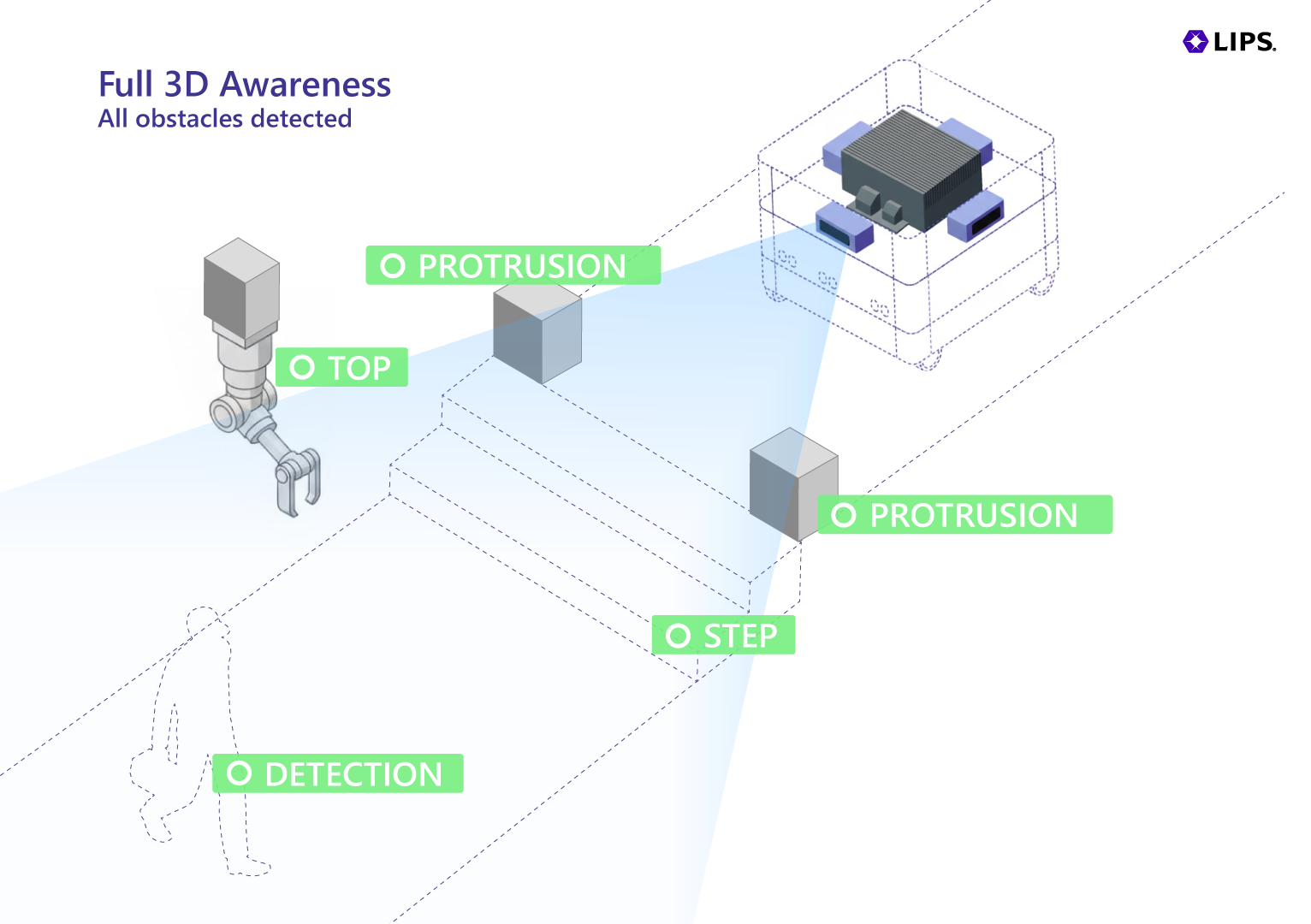
LIPSAMR™ replaces planar sensing with active stereo vision for AMR, generating dense, real-time 3D depth maps of the environment.
Key advantages of 3D perception for AMR navigation:
- Full volumetric awareness from floor to overhead structures
- Reliable detection of small, irregular, and partially occluded objects
- AI-powered obstacle and pedestrian detection at 4-6 meters while moving at operational speeds
- Smooth, predictive avoidance instead of abrupt emergency braking
Instead of guessing what exists outside a 2D plane, the robot perceives the world as it actually is three-dimensional.
Challenge 2: Fragmented and Complex Perception Integration
The Problem
Building a robust AMR perception stack from scratch is a major engineering burden. Teams often struggle with:
- Integrating LiDAR, cameras, IMUs, and compute from different vendors
- Writing and maintaining custom drivers
- Sensor fusion complexity and calibration drift
- Long development cycles and brittle systems
This fragmentation delays time-to-market and increases long-term maintenance costs for warehouse robotics deployment.
The LIPSAMR™ Solution: Unified, Deployment-Ready Architecture
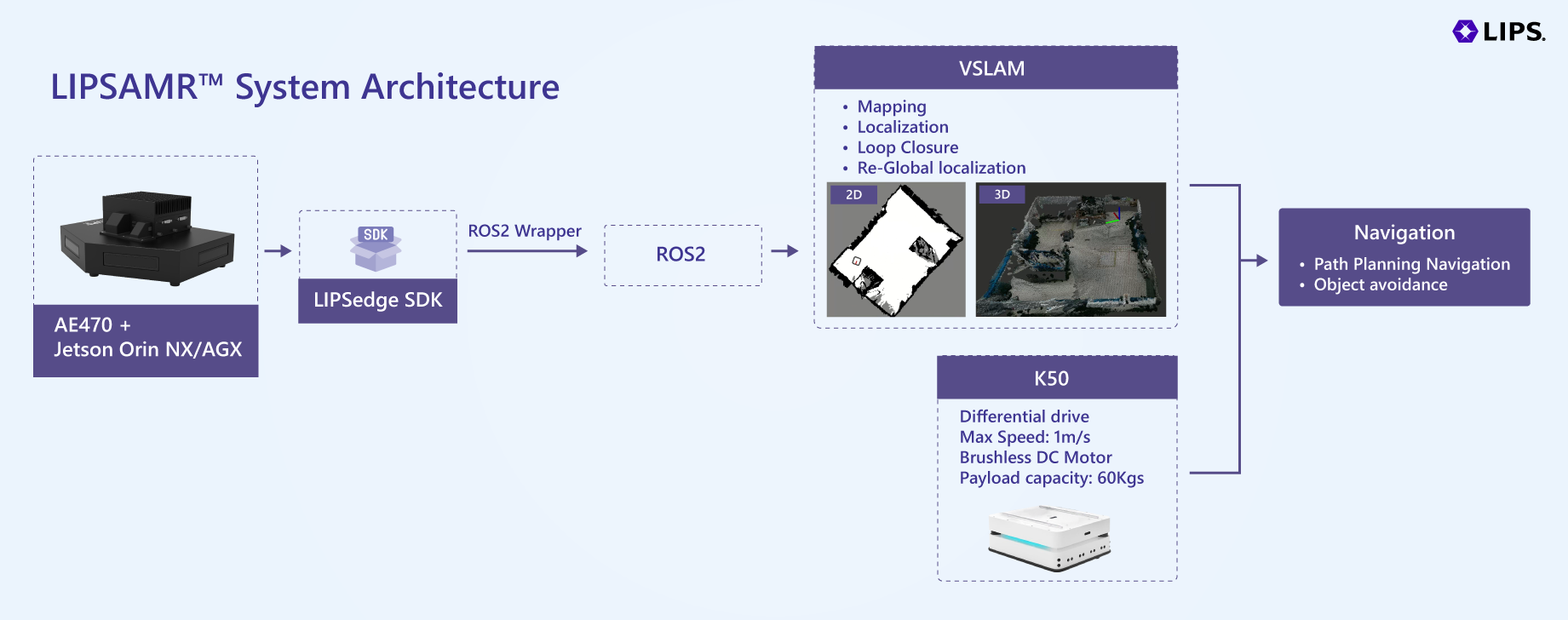
LIPSAMR™ is designed as a turnkey perception platform for AMRs, not a collection of disconnected components.
It integrates:
- Stereo cameras for depth and visual perception
- IMU for motion estimation
- NVIDIA Jetson AGX Orin for real-time AI and VSLAM processing
- ROS2 and NVIDIA Isaac ROS compatibility for seamless navigation stack integration
- Industrial CAN Bus support for reliable system communication
This unified, API-driven architecture allows engineering teams to focus on robot behavior and application logic, not perception plumbing, dramatically accelerating AMR development and deployment.
Download LIPSAMR Datasheet
Challenge 3: Navigation Failure in Feature-Poor or Dynamic Environments
The Problem
Traditional LiDAR-based SLAM relies on stable geometric features such as walls, pillars, or fixed structures.
In reality, warehouses often include:
- Wide-open loading bays
- Repetitive rack layouts
- Constantly changing inventory
- Moving forklifts, carts, and people
In these conditions, LiDAR SLAM can suffer from localization drift or complete failure, causing robots to lose their position or require frequent remapping.
The LIPSAMR™ Solution: Robust Visual SLAM (VSLAM)
LIPSAMR™ employs stereo camera-based VSLAM for AMR navigation, which leverages thousands of visual feature points such as:
- Floor textures
- Rack patterns
- Ceiling lights
- Environmental markings
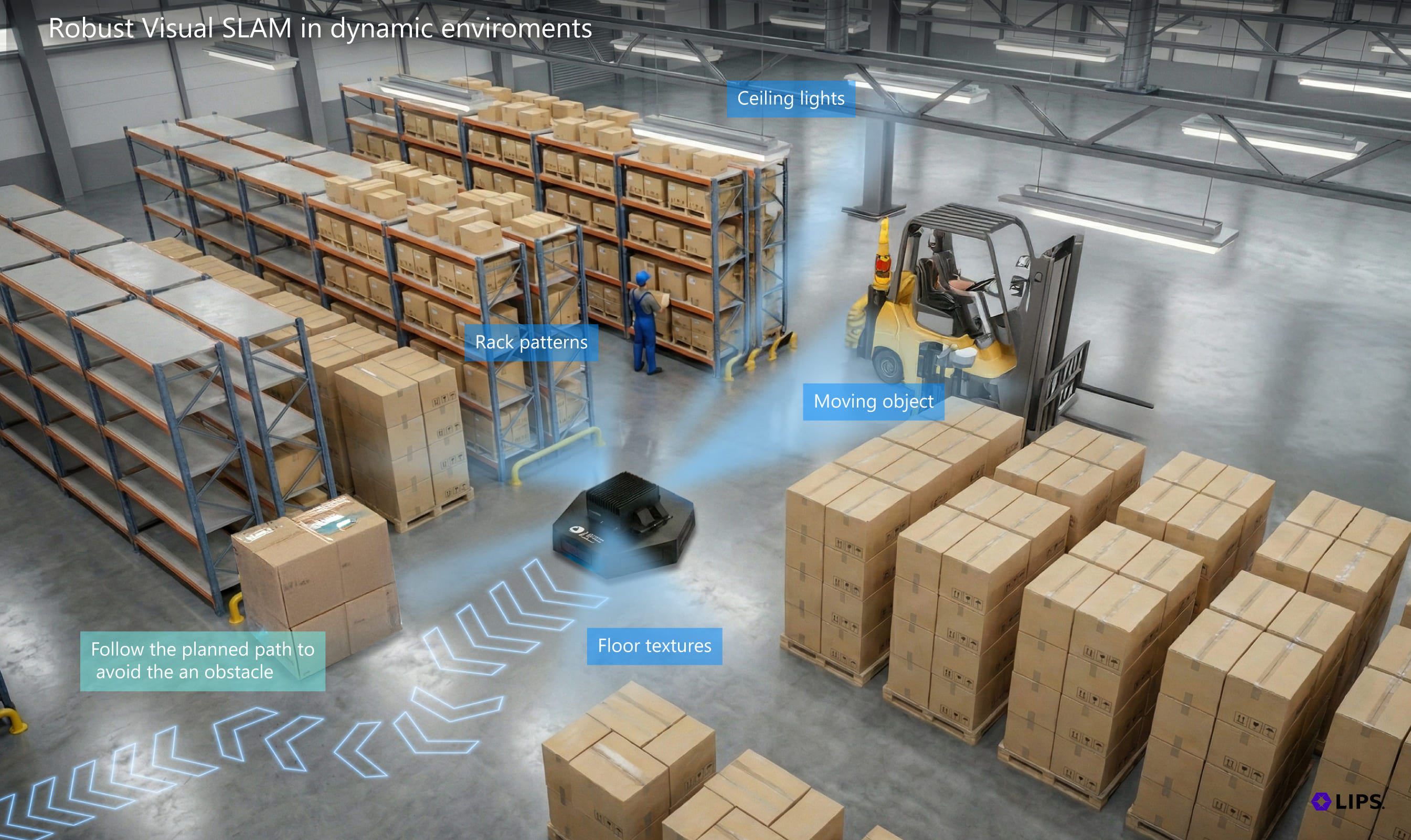
Unlike LiDAR, VSLAM for warehouse robots does not depend solely on geometry. It uses rich visual information, enabling:
- Stable localization in dynamic and repetitive spaces
- Faster map convergence
- Greater robustness when the environment changes
This results in consistent navigation accuracy for AMRs, even in conditions where LiDAR struggles.
Challenge 4: Lack of Semantic Understanding
The Problem
LiDAR answers only one question: How far away is something?
It cannot answer:
- What is it?
- Is it a human or a cart?
- Is it static or moving?
- Should the robot yield, stop, or proceed?
As a result, AMRs often behave conservatively and inefficiently treating humans, boxes, and structural obstacles exactly the same.
The LIPSAMR™ Solution: AI-Powered Semantic Perception
Because LIPSAMR™ is vision-based, it provides RGB + depth data to AI models running on Jetson AGX Orin.
This enables:
- Real-time object classification (humans, pallets, carts, forklifts)
- Context-aware navigation behavior
- Safer human-robot collaboration in factories
- Future expandability for visual cues such as signage, colors, or floor markings
In short, LIPSAMR™ doesn’t just see obstacles-it understands the scene.
Challenge 5: Limited Scalability and High Total Cost of Ownership (TCO)
The Problem
LiDAR remains one of the most expensive components in an AMR bill of materials (BOM). Scaling fleets quickly becomes cost-prohibitive, especially when:
- Multiple LiDARs are required for coverage
- Maintenance and recalibration are frequent
- Custom mechanical designs are needed
This limits flexibility and makes it difficult to adapt perception systems across different robot platforms.
The LIPSAMR™ Solution: Cost-Efficient, Scalable Vision Architecture
By eliminating LiDAR and leveraging stereo vision, LIPSAMR™ significantly reduces sensor costs for AMR deployment without compromising performance.
Additional scalability benefits:
- Support for 1 camera to 4-camera configurations
- Easy expansion toward 360° perception coverage
- Portability across different AMR form factors
- Lower BOM and easier global deployment
Request a Solution Blueprint
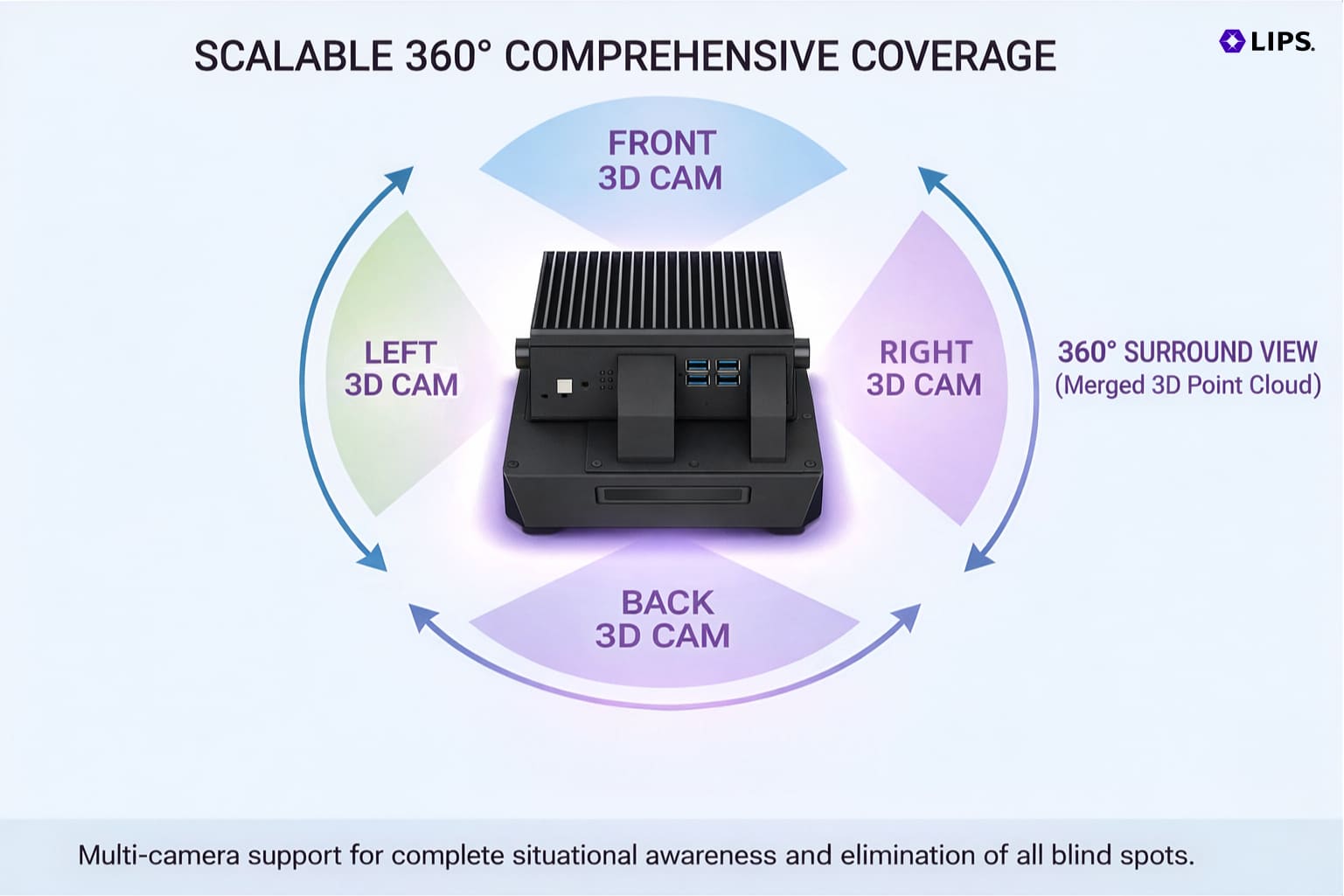
This makes LIPSAMR™ ideal not only for prototyping, but for large-scale commercial AMR fleets.
Conclusion: The Future of AMRs Is Vision AMR
The challenges limiting AMR adoption today-blind spots, fragile navigation, complex integration, and high costs are not inevitable. They are the result of relying on 2D sensing in a 3D world.
LIPSAMR™ demonstrates that a vision-based LiDAR-free perception architecture is not only viable, but technically superior for modern, dynamic, and human-centric factory environments.
The question is no longer “Can LiDAR navigate a warehouse?”
The real question is: “Can your perception stack scale, adapt, and truly understand reality?”
With LIPSAMR™, the answer is YES.
Learn more in our LIPSAMR™ product page: https://www.lips-hci.com/lipsamr-perception-devkit
or schedule a free consultation with our team:
FAQ for AMR deployment
1. What are the main challenges in AMR deployment for warehouses?
The top challenges in autonomous mobile robot (AMR) deployment include: 2D obstacle detection limitations causing safety risks, fragmented perception system integration, navigation failures in dynamic environments, lack of semantic understanding for intelligent behavior, and high total cost of ownership due to expensive LiDAR sensors. Over 60% of AMR deployment failures stem from poor perception and navigation accuracy, making vision-based 3D perception increasingly critical for successful warehouse automation.
2. How does vision-based AMR navigation compare to LiDAR-based systems?
Vision-based AMR navigation like LIPSAMR™ using stereo cameras and VSLAM (Visual SLAM) offers several advantages over traditional 2D LiDAR systems. It provides true 3D volumetric perception, detecting obstacles at multiple heights rather than just a single horizontal plane. Vision systems enable AI-powered semantic understanding to classify objects (humans, pallets, carts), allowing for context-aware navigation. Additionally, stereo vision is significantly more cost-effective than LiDAR while providing robust localization in feature-poor or repetitive warehouse environments.
3. What is LIPSAMR™ and how does it solve AMR perception challenges?
LIPSAMR™ is a LiDAR-free, vision-based perception platform designed for autonomous mobile robots. It integrates stereo cameras, IMU, and NVIDIA Jetson AGX Orin into a unified, deployment-ready architecture compatible with ROS2 and Isaac ROS. LIPSAMR™ addresses critical AMR challenges by providing: real-time 3D depth mapping for complete volumetric awareness, AI-powered object detection and classification, robust VSLAM navigation in dynamic environments, and scalable configurations (1-4 cameras) at lower cost than traditional LiDAR-based systems.