
The 3D camera trends in robotics and automation are shaping the new future of manufacturing processes worldwide. 3D cameras are no longer a niche technology—they are becoming foundational in robotics and factory automation. Here are five key trends to watch that will influence how 3D cameras in robotics reshape automation.
1. Edge AI Integration: The New Standard for Industrial 3D Vision
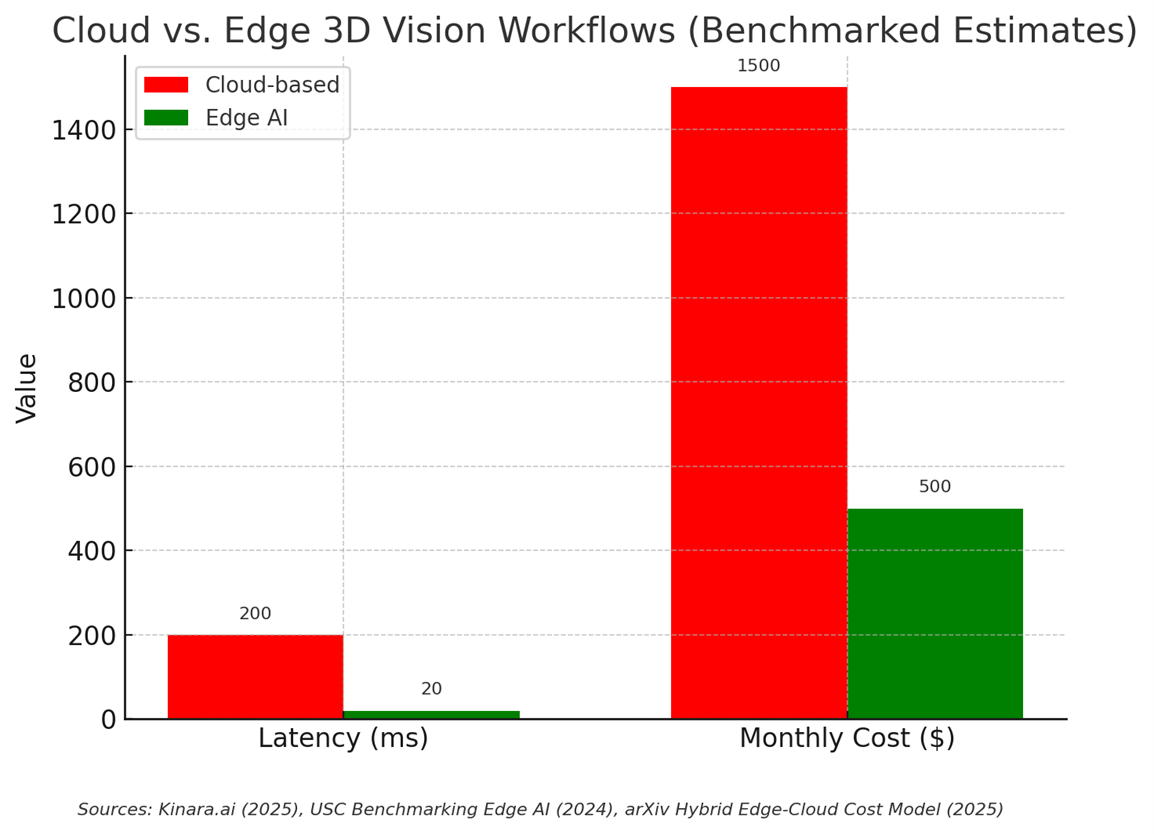
Traditionally, 3D imaging required powerful PCs or cloud processing. Now, 3D cameras in automation increasingly integrate edge AI chipsets that allow on-device inference. This shift reduces latency, improves uptime, and eliminates cloud bandwidth costs. For robotics, it means faster cycle times in pick-and-place tasks and real-time defect detection.
2. Hybrid Depth Technology: Merging Classical Sensors with AI-Powered Vision
Traditionally, 3D perception in robotics has relied on hardware-based depth sensors such as Time-of-Flight (ToF), stereo vision, and structured light. These methods are highly effective but can struggle in edge cases — for example, with transparent packaging, reflective metals, or environments with poor lighting.
At the same time, learned depth models powered by AI are advancing rapidly. These models use neural networks to infer depth from single or multiple images, filling in gaps where hardware sensors have limitations. For instance, an AI model can estimate the surface of a glossy object that confuses a ToF sensor, or infer depth in low-texture areas where stereo vision would normally fail.
The convergence of these two approaches — classical sensing and AI-based depth estimation — is emerging as a powerful solution:
- Sensor Fusion: Using AI together with different depth-sensing methods makes systems more reliable in tough environments.
- Smarter Depth Correction: AI can fill in gaps or fix errors from traditional sensors in real time.
- Lower Costs: In some cases, AI-based depth from a single camera can replace or reduce the need for expensive sensors.
The result will be more robust, hybrid depth systems that perform reliably even in the most challenging industrial environments, such as reflective metal assembly lines, glass-handling operations, or warehouses with mixed lighting.
3. Advanced Sensor Fusion: Building Resilient 3D Vision Systems
No single depth technology solves every problem. Leading manufacturers now deploy hybrid approaches: combining ToF + stereo + RGB data to handle texture-less parts, shiny metals, and variable lighting. This 3D camera trend is especially important in bin-picking and assembly, where diverse parts challenge single-sensor systems.
4. Cost-Effective Scaling: Making 3D Vision Accessible for Mass Deployment
3D cameras in robotics are dropping in price as new chipsets integrate more functions into compact, lower-power designs. What was once a premium option is now affordable enough for widespread deployment—from every robotic arm on a line to autonomous mobile robots (AMRs). Market forecasts show industrial 3D camera applications growing at ~14–15% CAGR (2024–2033). Simultaneously, average prices for 3D cameras are predicted to fall, driven by increases in volume and more adoption of less expensive 3D technologies such as time-of-flight.
5. Versatile Vision Platforms: From Single-Task to Multi-Application Systems
In the past, 3D cameras in automation were often deployed for one defined task — for example, measuring object dimensions or enabling robotic bin-picking. But as factories and warehouses become more dynamic, companies want versatile vision systems that can be reconfigured or extended as needs change.
This shift is being enabled by SDK-driven flexibility and advances in edge AI processing, allowing a single 3D camera to run multiple applications on the same hardware. Instead of buying separate cameras for inspection, navigation, and safety, manufacturers can now deploy a single device and load different functions as needed.
Example Applications:
- Random Bin-Picking: Depth data helps robots recognize and pick irregular objects from mixed bins.
- Quality Inspection: The same depth camera can detect surface defects or dimensional inaccuracies.
The result: 3D cameras are not just sensors, but rather vision systems that can evolve with factory requirements.
Key Takeaway
3D cameras are moving from a specialized add-on to a core enabler of intelligent robotics. Manufacturers that adopt edge AI, sensor fusion, and multi-purpose vision stacks will gain flexibility, resilience, and cost advantages in the years ahead.
Want to see how 3D vision could transform your workflow?
Contact LIPS at [email protected] for a consultation and demo tailored to your automation challenges.
————————————————————————————
Frequently Asked Questions About 3D Camera Trends
What are the main advantages of edge AI in 3D cameras?
Edge AI integration in 3D cameras reduces latency, eliminates cloud dependency, and enables real-time processing directly on the device. This results in faster cycle times for robotic applications and improved system reliability.
How do hybrid depth systems improve performance?
Hybrid depth systems combine classical sensors (ToF, stereo vision) with AI-powered depth estimation to overcome individual sensor limitations. This approach provides more robust performance in challenging environments with reflective surfaces, poor lighting, or transparent materials.
Why are 3D camera costs decreasing?
Cost reduction is driven by increased production volumes, integration of multiple functions into single chipsets, adoption of cost-effective technologies like time-of-flight, and growing market demand with projected 14-15% CAGR growth.
Can one 3D camera handle multiple tasks?
Yes, modern 3D cameras with SDK-driven flexibility and edge AI processing can run multiple applications on the same hardware, including bin-picking, quality inspection, navigation, and safety monitoring.
Which industries benefit most from these trends?
Manufacturing, warehouse automation, automotive assembly, electronics production, and logistics industries benefit significantly from these trends, particularly in applications requiring precision handling, quality control, and flexible automation.