
Learn what are 3D depth cameras and how they capture precise 3D data. Understand Stereo Vision, ToF, and Structured Light technologies, system architecture, and environmental accuracy factors.
2D Camera Issues and 3D Depth Camera Introduction
A 3D camera is an imaging device that enables the perception of depth in images to replicate three dimensions adding distance compared with 2D imaging cameras. Depth cameras use sensing technology to infer the distance (or depth) of points in the scene from the camera.
For decades, computer vision relied primarily on 2D image data—construct the world’s image with color information. While effective for tasks like object identification, 2D imagery lacks the crucial spatial dimension needed for advanced applications like object classification, autonomous robotics, pick-and-place automation, and immersive AR/VR.
Hence the need for the 3D depth camera. Unlike conventional 2D cameras, a 3D depth camera is an advanced imaging device that generates a depth map— an image where each pixel value represents a precise distance measurement rather than a color. This allows machines to perceive scene geometry, volumetric shapes, and spatial relationships in real-time.
For engineers transitioning from 2D CV to 3D perception, understanding the underlying mechanisms of these devices is the first step toward building robust spatial awareness systems. This article explores the fundamental principles, core sensing technologies, hardware architecture, and real-world accuracy factors of modern 3D depth cameras.
Depth Sensing Fundamentals: The Challenge of the Z-Axis
A standard digital sensor is inherently 2D. When a three-dimensional world is projected through a lens onto a flat sensor, depth information is lost in the process. To recover this lost Z-dimension, depth cameras must employ active measurement techniques or computational geometry.
Fundamentally, most commercially viable 3D depth sensing technologies rely on one of two core scientific principles:
Triangulation
Inspired by human binocular vision, this method calculates depth by observing the scene from two or more perspectives (stereo vision) or by observing the deformation of a known pattern projected onto a surface (structured light). It relies on knowing the precise baseline distance between sensors or projectors and measuring angular displacement.
Time-of-Flight (ToF)
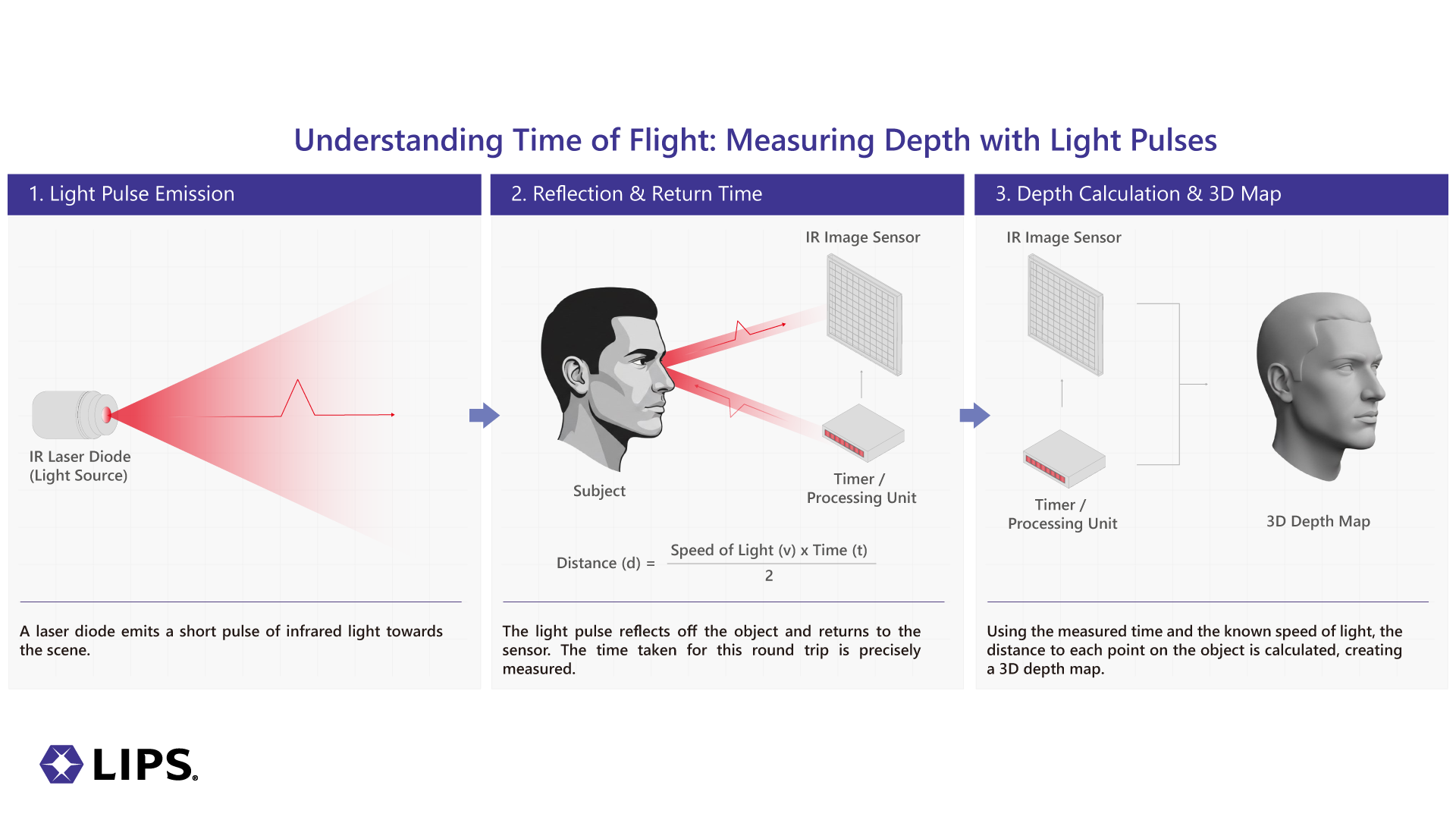
This is a radar-like approach that measures the time it takes for photons of light to travel from an emitter to an object and back to the sensor. Given that the speed of light is constant, the time delay directly correlates to distance.
Understanding which method a camera uses is crucial, as it dictates the camera’s range, accuracy behaviors, and environmental limitations.
For product selection, match the sensing method to the application environment, working distance, object surface, lighting conditions, and integration requirements. Review the LIPSedge 3D depth cameras portfolio for Active Stereo, ToF, and Structured Light options.
Core Technologies Explained: Stereo, Structured Light, and ToF
While the market offers various proprietary solutions, most robust industrial depth cameras utilize one of the following three architectures: stereo vision (passive or active), structured light or time-of-flight (ToF).
[A. Stereo Vision]
Stereo vision most closely mimics human depth perception. It uses two (or more) standard RGB or monochrome cameras separated by a known horizontal distance, known as the baseline.
The system works by identifying the same feature point in both the left and right images. Because of the physical separation of the lenses, the detected feature will appear at slightly different horizontal coordinates in each image. This difference is called disparity. Using epipolar geometry, algorithms calculate the depth: objects closer to the camera have higher disparity, while distant objects have lower disparity.
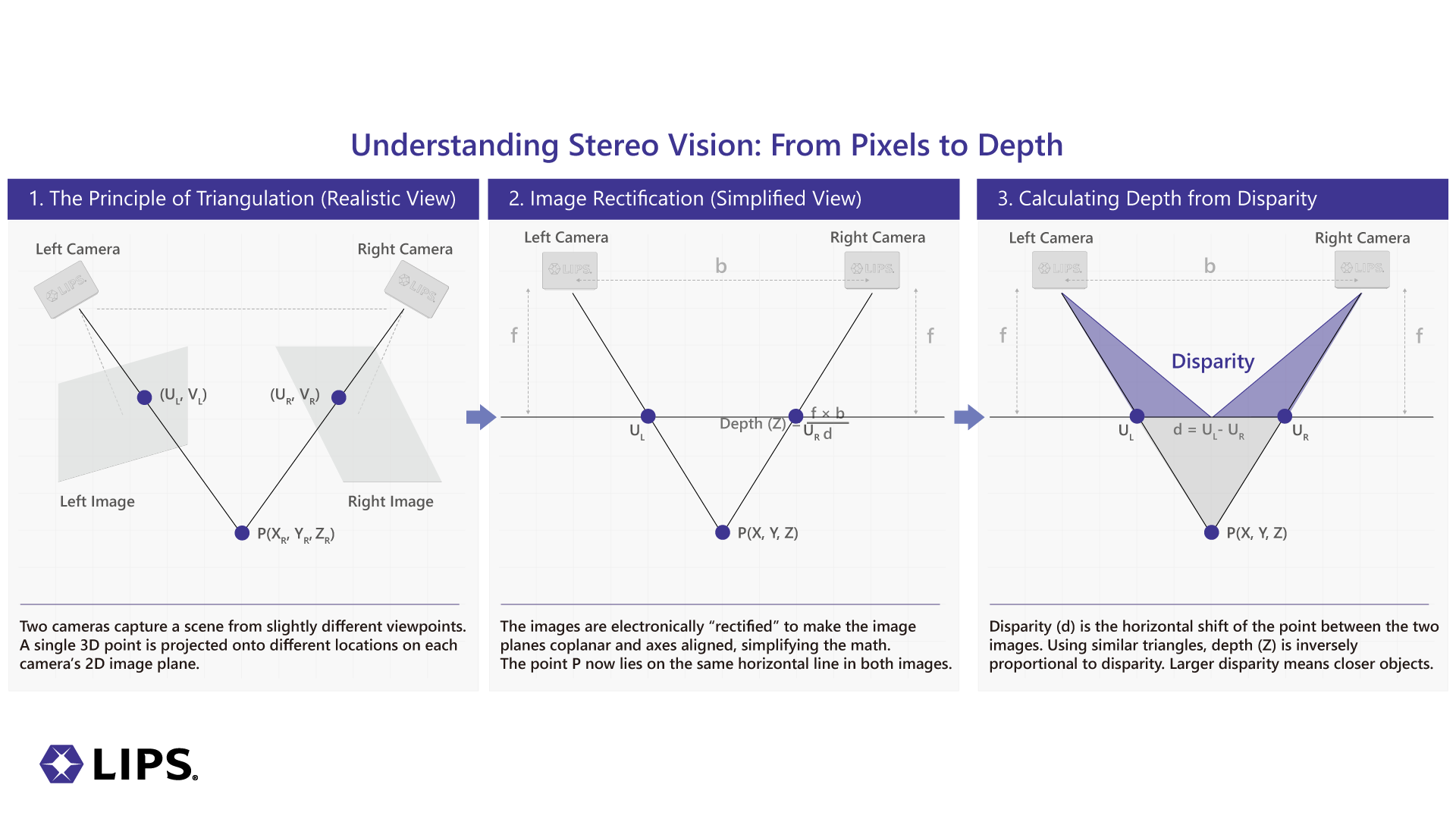
Passive / active stereo vision
Based on technological principles, stereo vision functions through two separate categories: passive and active. Passive stereo vision relies on ambient illumination to capture the textural contrast required for disparity matching algorithms, making them excel in well-lit conditions such as outdoor. By utilizing passive sensing to calculate depth, the architecture is energy efficient compared to the active stereo vision. However, in low-light environments, the lack of visible feature points prevents the system from resolving correspondence between the left and right images, causing depth perception to fail completely without external lighting assistance.
- Pros: Works well outdoors in bright sunlight; inexpensive hardware; provides RGB-D (color + depth) intrinsically.
- Cons: Heavily dependent on ambient lighting. It fails on low-light environment because the lack of visible texture prevents the algorithm from calculating disparity.
To overcome passive stereo’s reliance on environmental lighting, Active Stereo adds a projector—typically an infrared (IR) laser emitter—placed between the two stereo sensors.
The emitter projects a pattern of IR dots onto the scene. This projector does not need to be encoded; it simply adds artificial texture to bland surfaces. The stereo cameras (which must be IR-sensitive) then use these projected dots as feature points to calculate disparity.
- Pros: Solves the “blank wall” problem of passive stereo; works well indoors and in low light.
- Cons: Generally slower frame rates due to complex decoding and arithmetic operations, followed by high latency.
- Application area: applications such as AR/VR headsets and robotics. Active stereo technology typically offers a cost advantage and is frequently integrated with complementary technologies, such as structured light and ToF, particularly in the smart automotive sector.
For related product options, review AE Series Active Stereo cameras, S Series Edge AI stereo cameras, and the Active Stereo camera comparison.
[B. Structured Light]
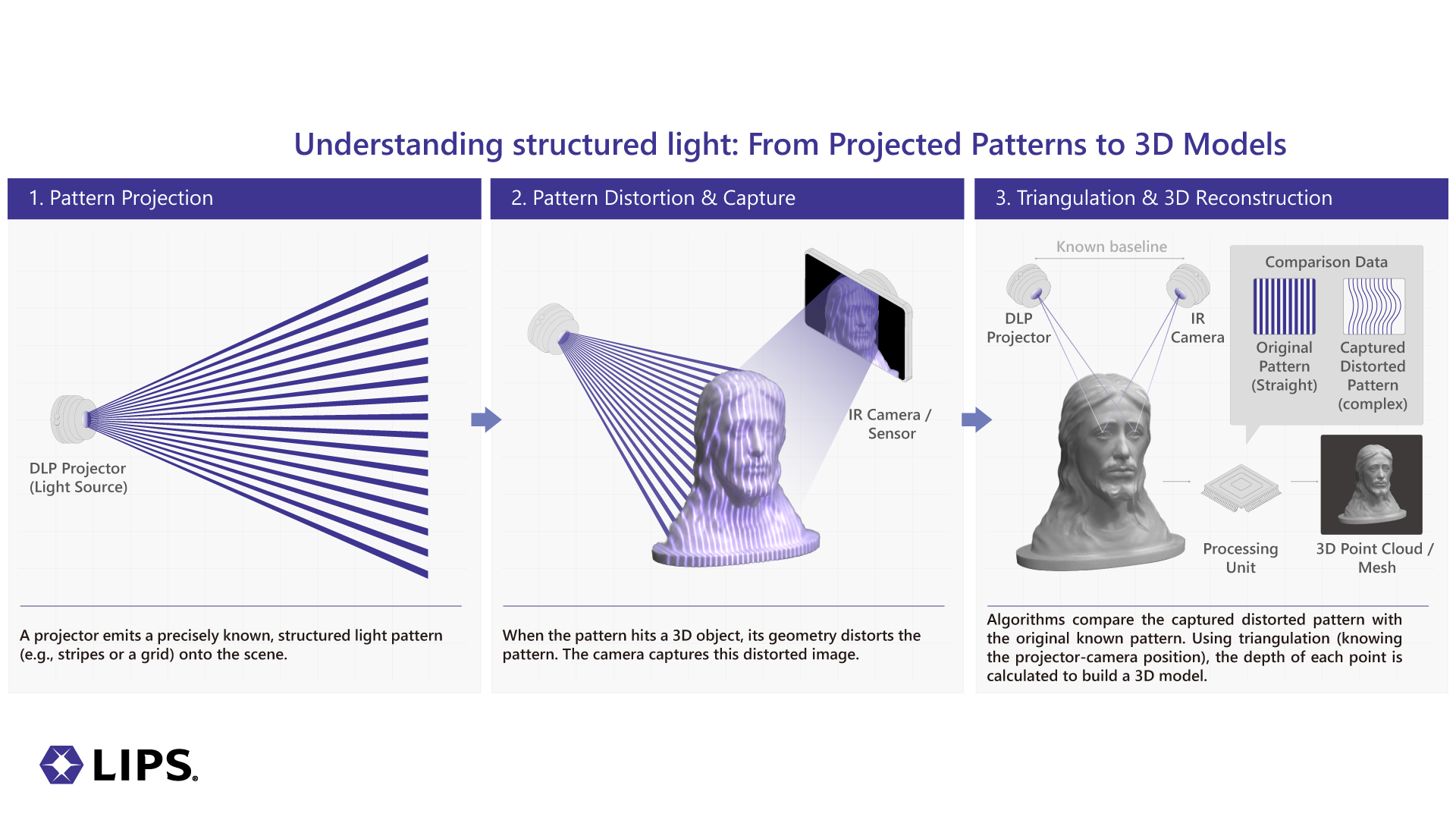
Structured Light is often confused with active stereo, but the operating principle is entirely different. It uses a single camera and a precise projector.
Instead of random dots, the emitter projects a known, coded pattern (such as Gray codes, phase-shifted stripes, or complex grids). When this pattern hits a 3D object, it distorts based on the object’s shape. The camera captures the deformed pattern, and the depth algorithm analyzes precisely how the received pattern deviates from the original projected pattern to calculate the geometry via triangulation.
- Pros: Extremely high accuracy and resolution at close-to-medium ranges.
- Cons: Performance remains heavily dependent on illumination and scene texture. The system fails on specular or mirror-like surfaces, where the lack of reliable feature points prevents the algorithm from accurately calculating disparity. It also struggles to resolve useful information in low-light or shadowed regions. Furthermore, the projected infrared pattern can be washed out by intense direct sunlight, effectively degrading the system to passive stereo performance in outdoor environments.
- Application ares: Facial recognition, motion sensing games or industrial automated optical inspection (AOI).
For related product options, review L Series Structured Light cameras and the Structured Light camera comparison.
[C. Time-of-Flight (ToF)]
ToF cameras are essentially light radar (LiDAR without moving parts). They illuminate the entire scene at once with a modulated light source (usually IR VCSELs) and measure the return time of the photons across the entire sensor array simultaneously.
There are two main types:
Direct ToF (dToF)
Uses SPAD (Single-Photon Avalanche Diode) sensors to measure the exact time interval between emission and detection of a single photon pulse. Very accurate at long ranges but expensive to manufacture with high resolution.
Indirect ToF (iToF)
The more common approach in modern depth cameras. It emits continuous, modulated light waves and measures the phase shift of the reflected light relative to the emitted light to calculate distance.
- Pros: Compact form factor; low processing overhead (depth data comes directly from the sensor); works in total darkness.
- Cons: Struggles with highly reflective surfaces (multipath interference); “phase wrapping” ambiguity can cause distance errors if an object is beyond the modulation range.
For related product options, review Time-of-Flight 3D cameras and the ToF camera comparison.
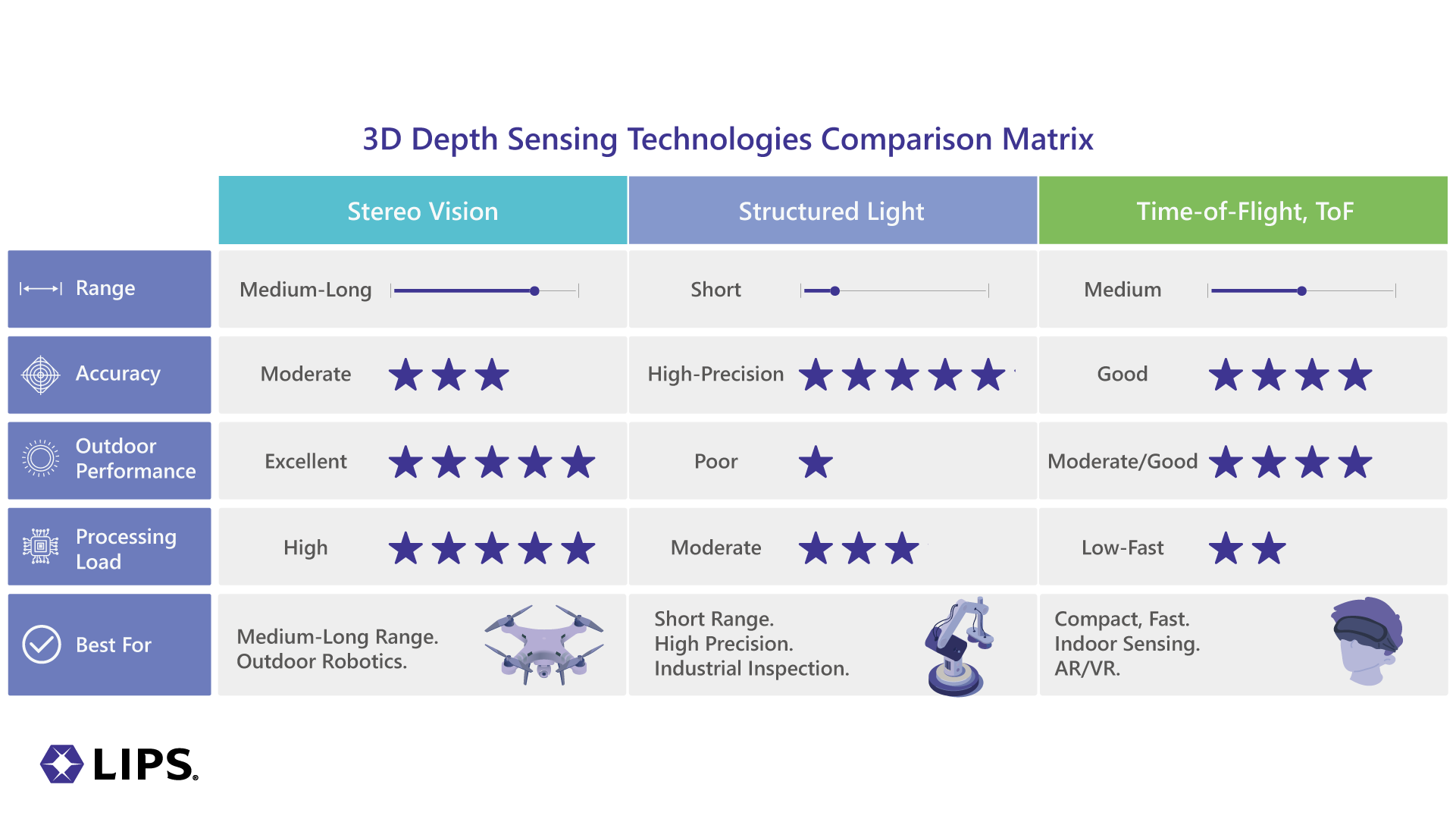
The image below summarizes the key differences between Stereo Vision, Structured Light, and ToF in accuracy, measurement range, and environmental performance. For a more detailed evaluation based on real-world application requirements, refer to the complete 3D depth technology selection guide.
System Architecture: Under the Hood
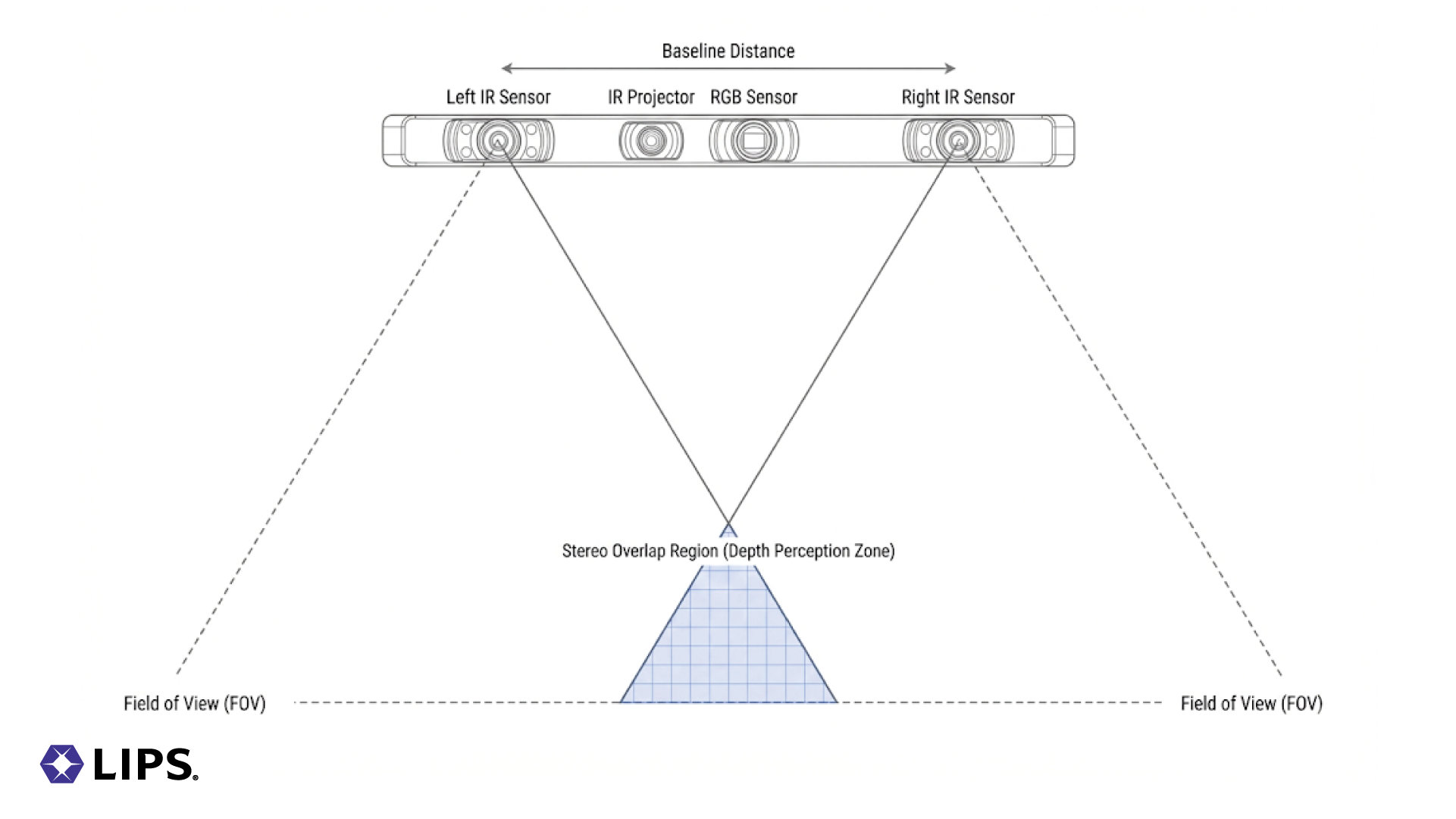
A professional-grade 3D depth camera is a tightly integrated opto-mechanical system. The quality of the depth data depends as much on the hardware alignment as the software algorithms.
A typical active stereo architecture, for example, includes:
Stereo Sensors (IR or Monochrome)
High-sensitivity global shutter sensors designed to capture sharp images without motion artifacts. Global shutters are critical for synchronizing temporally with IR pulses.
The Emitter (Projector)
Usually a Vertical-Cavity Surface-Emitting Laser (VCSEL) array operating in the near-infrared spectrum (e.g., 850nm or 940nm), invisible to the human eye.
RGB Sensor
A separate color sensor, often placed centrally, used to texture-map color data onto the 3D depth model.
The Baseline
The rigid physical distance between the left and right stereo sensors. A wider baseline increases depth accuracy at longer ranges but increases the minimum sensing distance (blind spot close to the camera).
Hardware Synchronization
A critical trigger signal that ensures the left sensor, right sensor, RGB sensor, and IR emitter all fire within nanoseconds of each other. Lack of precise sync leads to “tearing” and massive depth errors when the camera or subject move.
The 3D Reconstruction Workflow
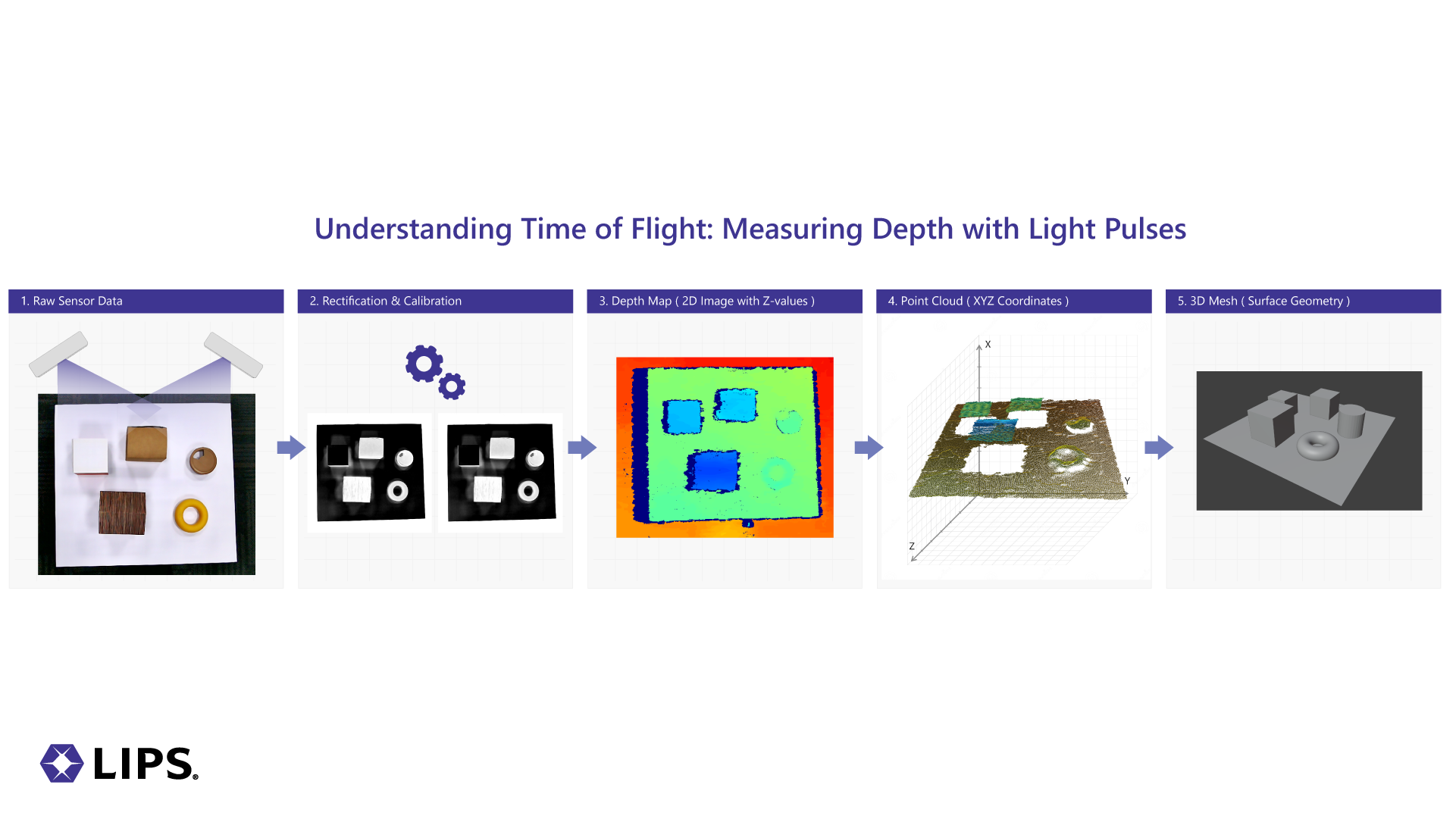
With the basic technology behind 3D cameras explained, this foundation allows for an exploration into understand how the camera transforms raw photon data into a usable and actionable 3D model for complex robotic applications. The pipeline generally follows these stages:
1. Raw Capture & Rectification
The sensors capture raw images. The LIPSedge SDK applies lens distortion correction and rectifies stereo images, mathematically aligning them so their scanlines are parallel, simplifying disparity matching.
2. Depth Map Generation
The core algorithm (disparity matching for stereo, phase decoding for ToF) runs on the host GPU. This results in a 2D image where every pixel value is a distance in millimeters.
3. Point Cloud Generation
The depth map is projected into 3D space using the camera’s intrinsic calibration parameters (focal length, principal point). Each pixel becomes an XYZ coordinate in space relative to the camera center.
4. Mesh Generation (Optional)
For applications needing surfaces rather than discrete points, algorithms connect neighboring points in the cloud to form triangles, creating a solid 3D mesh.
Accuracy and Environmental Factors
As an opto-mechanical system, 3D cameras have inherent limitations that dictate their performance and suitability across diverse environments. These constraints, often stemming from the interplay of optics, sensor technology, and mechanical precision, manifest in specific sensitivity to external factors. Understanding these limitations—particularly regarding environmental conditions and surface characteristics—is paramount for engineers to accurately assess a camera’s real-world viability and to mitigate potential inaccuracies in depth sensing. This limitations include:
Lighting Conditions
In environments that are too bright (typically exceeding 1000 lux), such as direct sunlight, infrared light overwhelms sensors, neutralizing the projected patterns essential for Active Stereo and Structured Light technologies and severely degrading their accuracy. Conversely, in excessively dark conditions, Passive Stereo systems fail entirely due to a lack of ambient light, while Time-of-Flight (ToF) and Active Stereo cameras, with their integrated illumination, continue to operate effectively.
Surface Reflectivity & Material
Aside from illumination, surface reflectivity and material properties also affect depth sensing accuracy. For example, when infrared hits specular surfaces, such as mirrors or polished chrome, they scattered unpredictably, causing Time-of-Flight (ToF) sensors to suffer from “multipath interference”, leading to inaccurate distances. Conversely, absorbing surfaces like black or matte materials absorb much of the emitted infrared light, resulting in a weak return signal to the sensor and consequently producing noisy data or gaps in the depth map.
Thermal Drift
As the camera operates, components heat up. The metal holding the sensors can expand microscopically, changing the crucial baseline distance or lens alignment. High-end industrial cameras include active thermal compensation algorithms to adjust calibration on the fly.
Conclusion
Having delved into the fundamentals of depth sensing, it becomes evident that selecting the optimal 3D depth camera is rarely a straightforward decision; rather, it requires a strategic balance amidst various trade-offs.
Among the primary technical pathways:
- Time-of-Flight (ToF): Offers distinct advantages in terms of lightweight form factors and high-speed processing.
- Structured Light: Excels in high-precision metrology at extremely close ranges.
- Passive Stereo Vision: Relies solely on ambient light and the parallax between two cameras (mimicking human vision) to calculate depth. Its primary advantages are lower cost, reduced power consumption, and immunity to bright outdoor sunlight, making it suitable for long-range applications such as autonomous driving. However, its significant challenge lies in accuracy degradation on textureless surfaces (such as white walls or monochromatic floors) or in low-light environments, where matching algorithms struggle.
- Active Stereo Vision: Overcomes the limitations of passive systems by projecting an artificial infrared pattern to supplement environmental texture. This approach mitigates the failures of passive vision in low-texture scenarios, providing the most stable and versatile balance for variable indoor lighting conditions.
Ultimately, the final selection hinges on the specific business requirements of the application environment, the necessary operational range, and acceptable measurement tolerances. By understanding these fundamental operating principles, engineers can look beyond marketing specifications to select the architecture that truly aligns with their practical needs.
Evaluate the right 3D depth camera for your application
Choosing between Active Stereo, Structured Light, and Time-of-Flight depends on more than the sensing principle alone. Engineers also need to consider working distance, object surface, lighting conditions, motion, form factor, SDK support, and the target deployment environment.
Explore LIPSedge 3D depth cameras, contact LIPS to discuss your 3D vision project, or buy 3D depth cameras from the LIPS Store.
Compare depth camera models: Active Stereo | Time-of-Flight (ToF) | Structured Light
Frequently Asked Questions (FAQ)
Q: How does a 3D depth camera measure distance using light or image patterns?
They generally use one of two methods. Triangulation (Stereo and Structured Light) measures the angular shift of an object observed from two perspectives to calculate distance geometrically. Time-of-Flight measures the physical time it takes for light emitted by the camera to bounce off an object and return to the sensor.
Q: Which 3D depth sensing technology offers the highest measurement accuracy, and under what conditions?
For short-range, static applications (like industrial inspection), Structured Light usually offers the highest sub-millimeter accuracy. For medium ranges in varied lighting, Active Stereo provides the best balance of accuracy and reliability. Direct ToF is often best for very long-range accuracy (hundreds of meters), such as in automotive LiDAR.
Q: Why do lighting and surface materials affect depth sensing accuracy?
Most active depth cameras (ToF, Active Stereo, Structured Light) rely on projecting and reading Infrared light. Bright sunlight contains massive amounts of IR, which “drowns out” the camera’s projector. Conversely, dark or matte surfaces absorb the camera’s IR signal rather than reflecting it back, leading to weak signals and noisy depth data.