
Introduction: Why AMR Pallet Detection Remains a Warehouse Automation Bottleneck
As global supply chains accelerate, the pressure on warehouse automation has never been higher. Autonomous Mobile Robots (AMRs) and automated forklifts are rapidly evolving from fixed-path systems into intelligent agents navigating dynamic, unpredictable environments.
Yet, despite major advances in navigation and mobility, one critical bottleneck remains:
Reliable pallet detection and interaction in real-world conditions.
While moving from Point A to Point B is largely a solved problem, the physical act of identifying, aligning with, and picking up a pallet introduces layers of environmental complexity that traditional perception systems struggle to handle.
In this article, we examine the core challenges of automated pallet handling and how LIPS 3D vision for AMR pallet detection supports perception in complex warehouse environments.
The Limitations of Traditional Approaches
Many existing systems still rely on conventional methods that struggle under real-world conditions:
2D Vision Systems
- Lack depth perception
- Sensitive to lighting variations
- Limited ability to estimate orientation accurately
Marker-Based Solutions
- Require environment modification
- Not scalable across large or dynamic facilities
Manual Correction Workflows
- Reduce operational efficiency
- Increase labor dependency
- Undermine automation ROI
As automation scales, these limitations become increasingly difficult to manage.
Why Traditional Sensors Struggle with AMR Pallet Detection
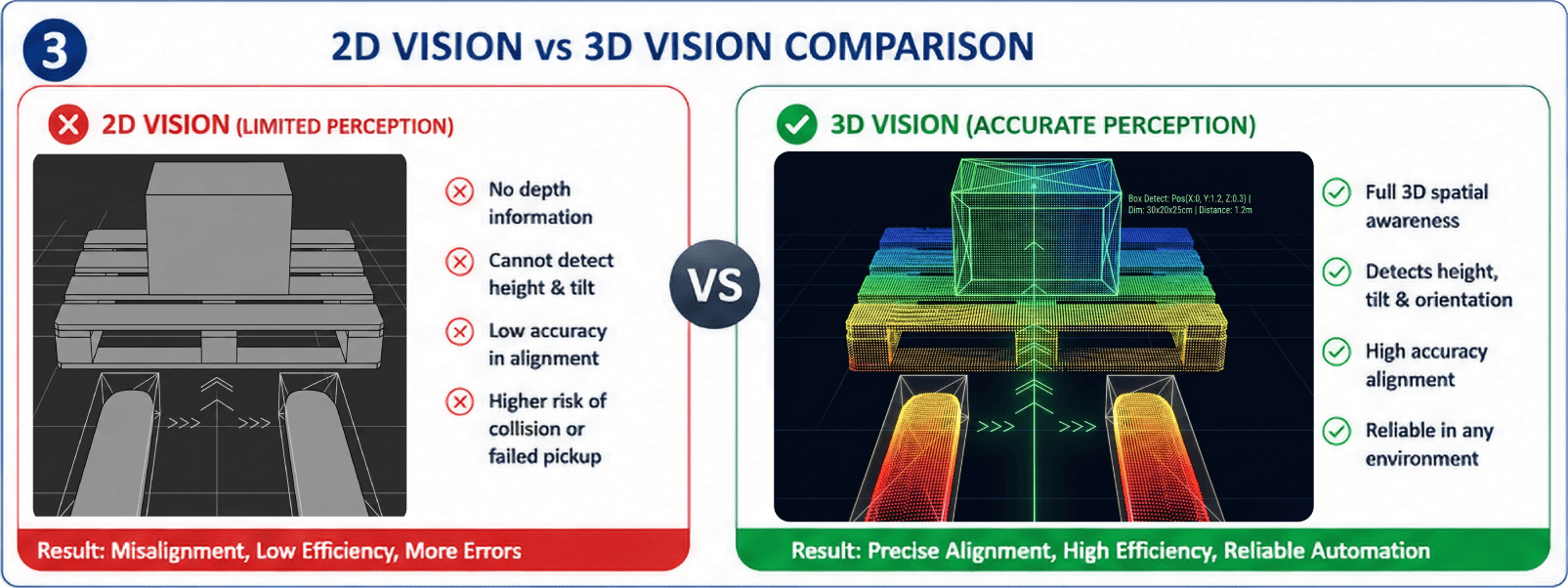
On a busy logistics floor, standard 2D cameras and 2D LiDAR sensors hit critical performance barriers due to three real-world issues:
- Angular Displacements (The Real-World Tilt): Pallets are rarely dropped at perfect 90-degree angles. If an object is misaligned by even a few degrees, an AMR relying on rigid 2D bounding boxes will miscalculate its approach, strike the pallet stringer and trigger an emergency halt.
- The Shiny Shrink-Wrap Deficit: The vast majority of industrial freight is wrapped tightly in clear plastic stretch-wraps. This material creates blinding glare for standard vision systems and produces fragmented, noisy depth data on low-end cameras, obscuring the fork pockets entirely.
- Low-Contrast Environments: Warehouses utilize an unpredictable mix of weathered wood, bright blue CHEP pallets, and jet-black plastic pallets. In dimly lit aisles, 2D neural networks struggle to segment a dark pallet sitting on dark concrete, leading to docking failures.
When these failures occur, the robot may halt for manual intervention, reducing operational efficiency.
What a 3D Vision System for Pallet Detection Systems Must Deliver
To overcome these challenges, pallet detection must evolve beyond basic image recognition.
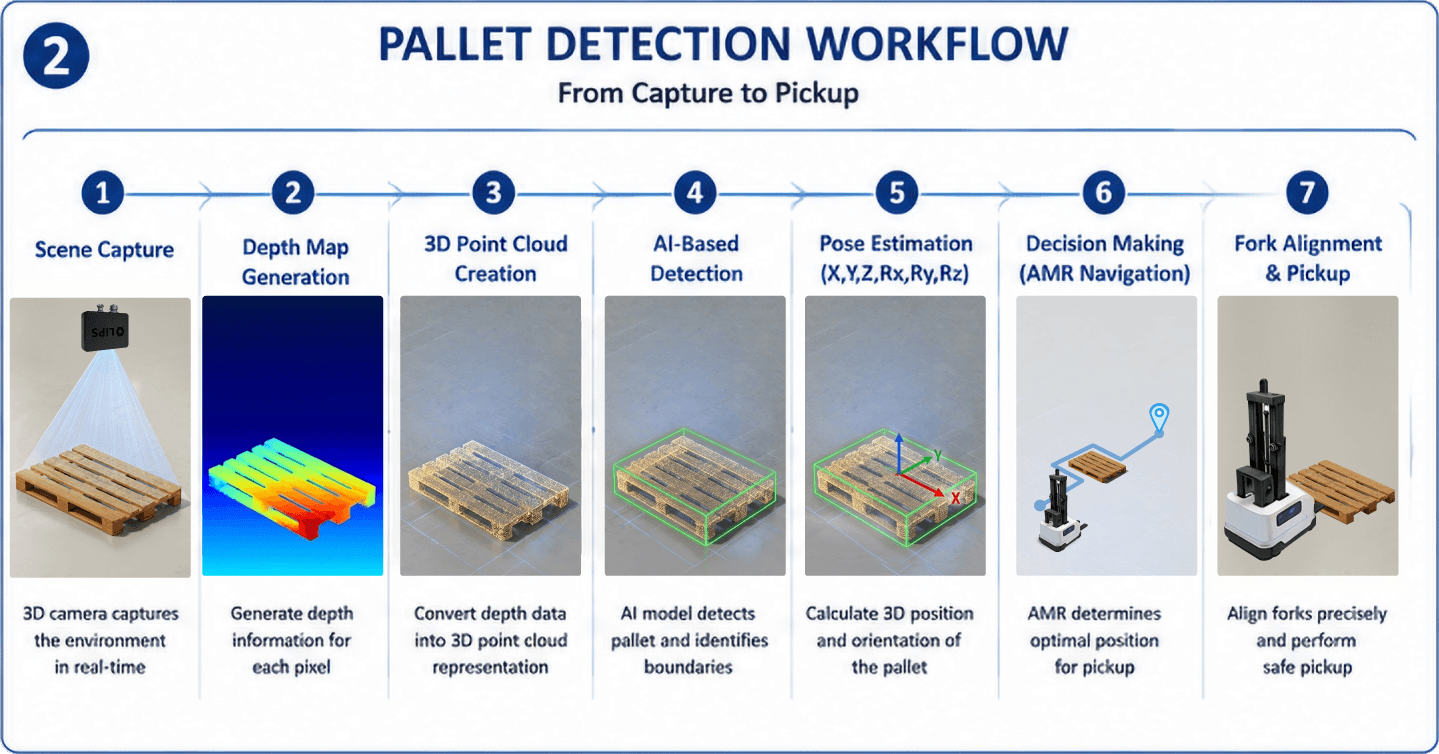
A modern system should provide:
- True 3D spatial awareness for accurate depth and geometry understanding
- Real-time pose estimation (X, Y, Z, Rx, Ry, Rz) for precise alignment
- Robustness to environmental variability, including lighting and material differences
- Edge AI processing for low-latency, real-time decision-making
- Seamless integration with AMR systems for autonomous operation
Only by meeting these criteria can pallet detection support scalable, real-world automation.
The LIPSolution™ Framework: A Complete Robotics Vision and Edge AI Solution for AMRs
To address these requirements, a new class of perception systems has emerged-built on 3D sensing and edge AI.
Platforms such as LIPS provide a tightly integrated hardware-software ecosystem designed to deliver reliable pallet detection in complex environments.
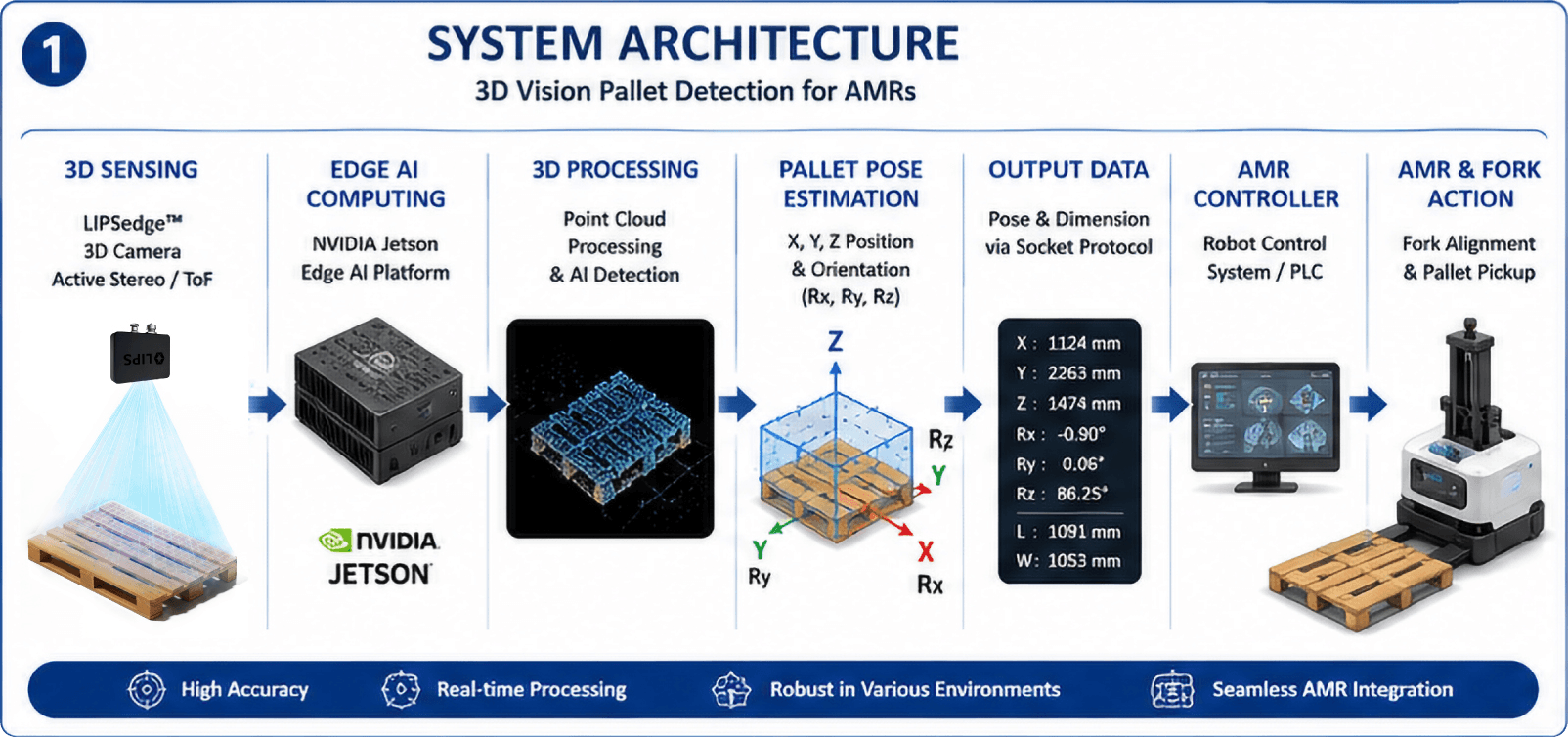
1. LIPSedge™ Ruggedized Industrial 3D Depth Cameras
At the foundation are advanced 3D cameras using Active Stereo and Time-of-Flight (ToF) Camera technologies.
By leveraging active infrared (IR) illumination, these systems:
- Operate independently of ambient lighting
- Minimize glare from reflective surfaces
- Capture dense, high-quality 3D point cloud data
2. Advanced 6-DOF Pose Estimation for Pallet Alignment
Detection alone is not enough; the robot must understand spatial orientation.
Modern 3D AI systems calculate full 6 Degrees of Freedom (6-DOF):
- Translation (X, Y, Z): Exact position relative to the robot
- Rotation (Roll, Pitch, Yaw): Precise angular alignment
For pallet pickup workflows, 6-DOF outputs can support:
- Fork-positioning evaluation based on measured translation data
- Alignment evaluation based on measured rotation data
- ~1.5° rotational accuracy
- ~2% distance precision within 2 meters
3. Native ROS2 and NVIDIA Isaac Integration for AMR Development
Robotics engineers need an integration path that fits established development environments. The LIPSolution™ software stack integrates natively into the leading industrial development platforms. By providing full wrappers for ROS / ROS2 (Robot Operating System) and compatibility with NVIDIA Isaac ROS perception layers, the LIPSedge™ SDK streams clean, actionable coordinate arrays directly into your robot’s existing navigation path-planner via simple API calls.
Enabling Intelligent AMR Pallet Detection with 3D Vision and Edge AI
This is where advanced 3D vision platforms redefine what’s possible.
By leveraging depth-sensing technologies such as active stereo and Time-of-Flight (ToF), modern systems can generate rich spatial data that goes far beyond traditional imaging.
Key capabilities include:
- Accurate pallet localization in 3D space
- Orientation detection with sub-degree precision for pallet alignment
- Reliable performance across mixed pallet types
- Stable operation in complex, real-world environments
Combined with edge AI processing, these systems enable AMRs to make fast, precise, and autonomous decisions.
See LIPSAMR™ Perception DevKit
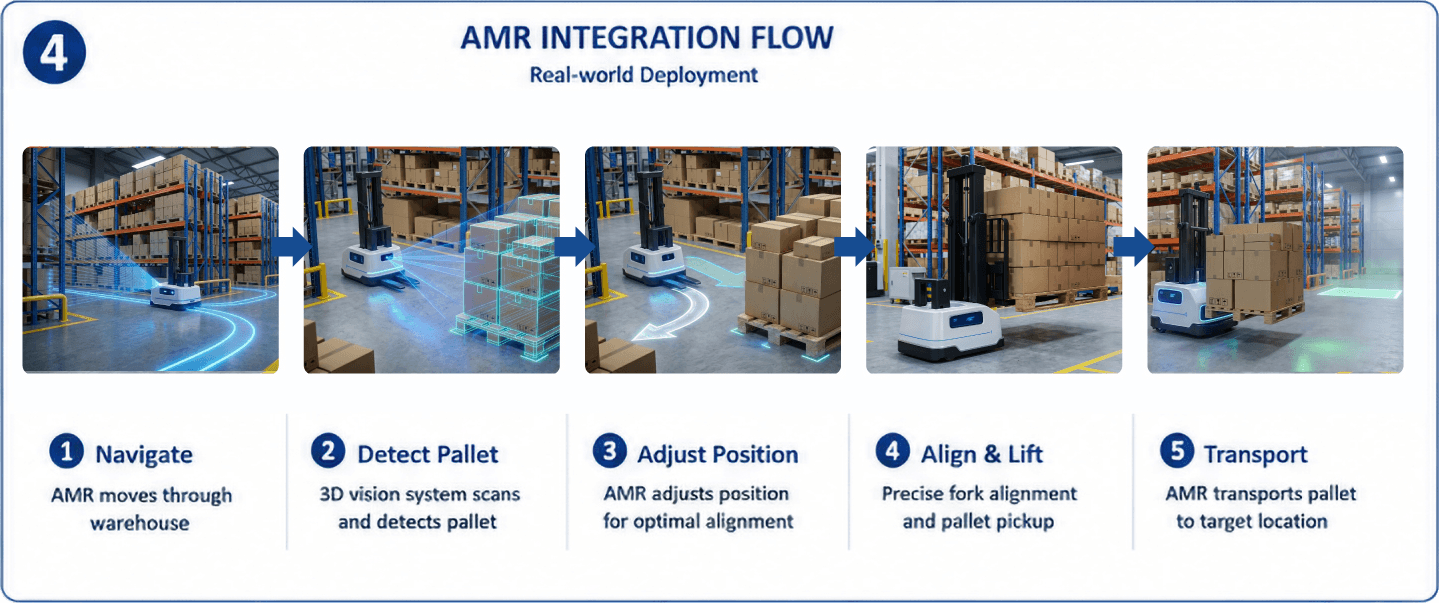
Application Scenarios Across Industries
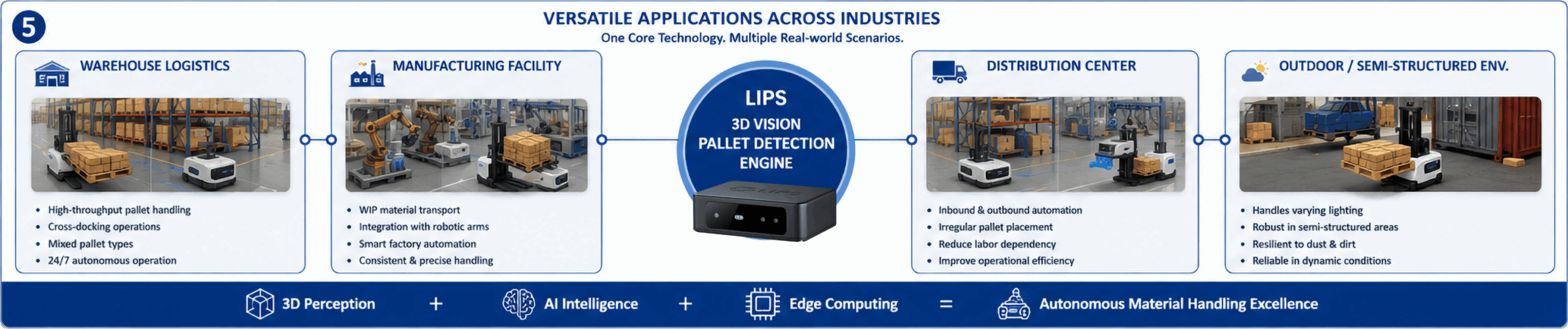
Rather than being limited to a single use case, intelligent pallet detection supports a wide range of industrial scenarios:
Warehouse & Logistics Operations
- High-throughput pallet movement
- Cross-docking and staging areas
- Mixed SKU handling environments
Manufacturing Facilities
- Work-in-progress material transport
- Integration with robotic arms and conveyors
- Smart factory automation workflows
Distribution Centers
- Automated inbound and outbound pallet handling
- Handling irregular pallet placements
- Reducing dependency on manual labor
Robotics & System Integration
- Faster deployment cycles for AMR solutions
- Reduced customization effort
- Scalable across multiple customer environments
The Impact on Automation Performance
When pallet detection becomes reliable and precise, the benefits extend throughout the entire operation:
- Reduced failed pickup attempts
- Improved AMR cycle efficiency
- Lower operational downtime
- Enhanced system scalability
Most importantly, it enables organizations to move closer to fully autonomous material handling.
The Future of AMR Perception
As industries continue to adopt automation at scale, the role of perception systems will only grow in importance.
The shift is clear:
From → Basic detection
To → Intelligent spatial understanding
3D vision, combined with AI and edge computing, is emerging as a foundational layer in next-generation robotics systems.
Pallet detection is no longer just a functional requirement-it is a strategic enabler of automation success.
Evaluate Your Robotics Vision for AMR Pallet Handling with LIPS
Building an autonomous fleet for dynamic warehouse operations requires perception systems designed for real-world variability. LIPS supports AMR development with LIPSedge™ 3D depth cameras and LIPSolution™ robotics automation resources for integration evaluation.
- Ready to Build? Explore our open-source tools and developer resources on the LIPSedge™ SDK Sample Repository.
- Evaluate AMR Perception? Explore the LIPSAMR™ Perception DevKit for AMR 3D vision and integration evaluation.
- Collaborate with Us: Contact LIPS to evaluate LIPSolution™ and LIPSedge™ resources for your AMR pallet handling application.
Frequently Asked Questions (FAQ)
Q: What is AMR pallet detection?
A: AMR pallet detection is the perception task of locating a pallet and estimating information needed for a mobile robot to approach and interact with it. In dynamic warehouse environments, 3D vision can provide spatial data for evaluating pallet position and orientation beyond a flat 2D image.
Q: How can LIPSolution™ support 3D vision for AMR applications?
A: LIPSolution™ is positioned by LIPS as a robotic automation solution for mobile robots and robotic arms using AI-powered 3D vision. Its official product information identifies NVIDIA Isaac™ integration, ROS integration, and LIPSAMR™ Perception DevKit resources for AMR perception and navigation evaluation.
Q: Which LIPS resources are relevant when evaluating robotics vision and edge AI for pallet handling?
A: For hardware evaluation, LIPSedge™ includes industrial 3D depth camera options based on Active Stereo and Time-of-Flight technologies. For an AMR automation path, LIPSolution™ and LIPSAMR™ provide the product context for evaluating perception, integration, and navigation requirements.