
Strengthening Urban Governance with LIPS Edge AI Traffic Vision for Smart Intersection Real-Time Detection
The New Taipei City Government, as a large urban traffic management authority, faces a complex and dynamic road environment alongside ever-growing traffic management demands. For years, both signalized and unsignalized intersections lacked sufficient real-time detection capabilities, leading to reduced traffic efficiency, elevated accident risk, and pedestrian safety concerns. To improve traffic governance, the city government deployed the LIPS Edge AI Traffic Vision (Intersection AI Monitoring) algorithm for early-stage deployment at key intersections. The solution delivers traffic flow monitoring, pedestrian detection, intersection pre-warning, and event awareness capabilities — supporting risk management and reinforcing smart transportation infrastructure. This project significantly enhanced intersection observability and established a scalable technical foundation for citywide expansion, laying the groundwork for long-term smart traffic development.
The Challenge of High-Density Traffic Environments: Why Intersection AI Monitoring?
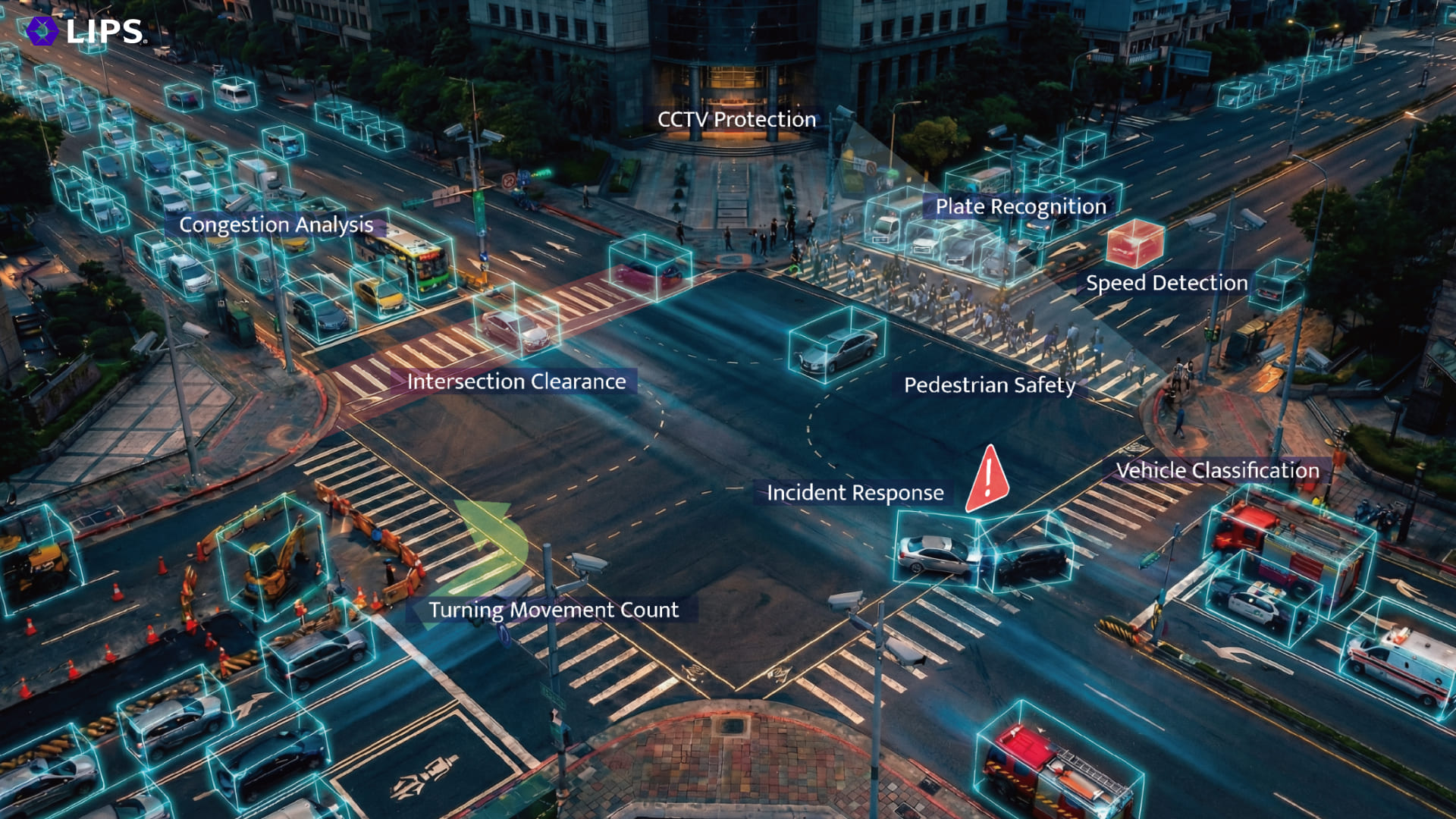
New Taipei City features high traffic density and diverse road configurations, including signalized arterial roads and a large volume of unsignalized side streets. Existing surveillance equipment was primarily designed for video recording and evidence collection rather than real-time detection, making it difficult for management authorities to monitor traffic flow conditions, pedestrian behavior, and accident risks. During peak hours, the inability to detect congestion or abnormal activity in real time affected traffic efficiency, incident response speed, and pedestrian safety. The city government sought an Intersection AI Monitoring solution to improve traffic order, reduce accident risk, and establish a sustainable, long-term data foundation.
At signalized intersections, the city lacked high-accuracy traffic flow monitoring tools, making dynamic signal adjustments difficult. At unsignalized intersections, the absence of real-time detection and pre-warning capabilities for pedestrians and vehicles further elevated accident risk. These challenges made it imperative for the government to adopt an AI solution with Smart Intersection Real-Time Detection capabilities — one deployable at scale and capable of sustained city-wide operation.
Traditional infrared detectors and magnetic loop sensors could not cover all road configurations, nor provide granular traffic classification data. Combined with high maintenance costs, these technologies were unsuitable for city-scale deployment. The city required a solution capable of multi-site deployment, real-time operation, and horizontal scalability — leading to the deployment of the LIPS Edge AI Traffic Vision solution.
LIPS Edge AI Traffic Vision Solution: From Architecture Selection to Intersection Deployment
The New Taipei City Government selected LIPS primarily because its vision AI solution operates simultaneously at both signalized and unsignalized intersections with high-speed inference capabilities suited for edge device deployment. Key advantages include: high-FPS inference performance, customizable intersection zone configuration, detection of vehicles, pedestrians, and events, and rapid integration into existing camera infrastructure.
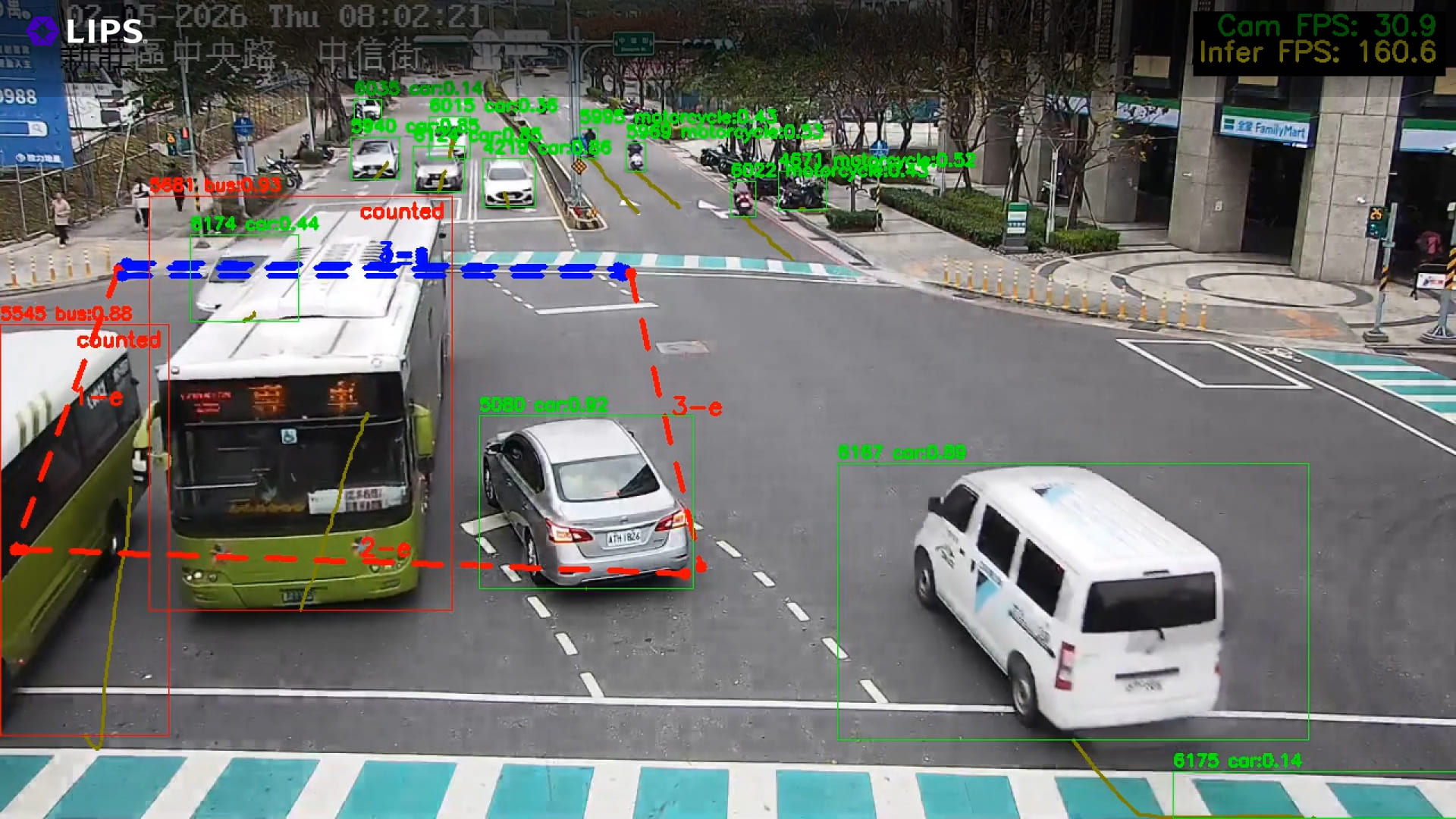
LIPS Edge AI Traffic Vision delivered a complete package for this project, including traffic flow detection, pedestrian detection, intrusion detection, turning behavior detection, intersection pre-warning modules, and a data-reporting mechanism for backend traffic governance. The algorithm adapts to varying camera heights, angles, and ambient lighting conditions, providing high deployment flexibility.
Deployment proceeded in three phases: preliminary site survey and ROI calibration, edge device installation at intersections, and detection zone labeling with model parameter tuning. During actual deployment, challenges including lighting variations and narrow alley viewing angles were addressed through model fine-tuning to progressively improve detection accuracy. This project is expected to serve as the foundational pilot for New Taipei City’s large-scale deployment expansion.
Early Outcomes and Urban Governance Benefits: Enhanced Intersection Safety, Monitoring Capability, and Early Warning Systems
Early outcomes include: stable system performance across diverse environmental conditions, successful real-time return of Smart Intersection detection data and event footage, and effective pedestrian/vehicle pre-warning displays at unsignalized intersections. Quantitative comparative data will be incorporated at a later stage to optimize traffic signal decision-making and urban traffic governance.
On the qualitative side, preliminary user feedback indicates that traffic management authorities have achieved significantly improved monitoring coverage at intersections beyond direct line of sight; risks at pedestrian crossings and unsignalized intersections have been substantially reduced; and overall governance can now be conducted in a more data-driven manner. This project is expected to drive a larger-scale traffic AI upgrade and decision-making process optimization.
FAQs: Intersection AI Monitoring — Deployment, Integration, Applications, and Scalability
Q: Is the solution applicable to other cities?
A: LIPS Edge AI architecture can be directly replicated to other cities — only detection zone re-labeling is required.
Q: Can it integrate with existing traffic signal systems?
A: Yes. Integration with signal controllers is available via API for dynamic signal adjustment.
Q: Does it require camera replacement?
A: In most cases, existing cameras can be retained — only viewing angle and stream quality adjustments may be needed.
Q: How long does deployment take?
A: A typical intersection takes approximately 1–2 weeks from site survey to go-live.
Q: How do we get started?
A: Provide intersection footage and your requirements for a preliminary assessment.
Q: What is Intersection AI Monitoring, and how does it differ from traditional surveillance cameras?
A: Intersection AI Monitoring refers to deploying vision systems with real-time AI inference capabilities at intersections that actively detect vehicles, pedestrians, and events while outputting structured data in real time. Traditional surveillance cameras are primarily designed for video recording and evidence collection — they cannot actively detect incidents or trigger alerts. Intersection AI Monitoring, by contrast, delivers real-time information at the moment an event occurs, enabling management authorities to transition from reactive response to proactive governance.
Q: How does LIPS Edge AI Traffic Vision operate at urban intersections?
A: LIPS Edge AI Traffic Vision deploys AI inference computing directly onto edge devices at each intersection, eliminating the need to transmit video to remote servers. The system adapts to varying camera heights, angles, and lighting conditions, with detection covering traffic flow, pedestrians, intrusions, and turning behavior. Data is delivered in real time to urban traffic governance platforms via backend API, supporting dynamic signal adjustments and risk pre-warning.
Q: What urban traffic management challenges can Smart Intersection Real-Time Detection address?
A: Smart Intersection Real-Time Detection addresses three primary management pain points: (1) signalized intersections lack high-accuracy traffic flow data, making dynamic signal timing adjustments difficult; (2) pedestrian-vehicle conflicts at unsignalized intersections cannot be warned against in advance, resulting in elevated accident risk; (3) monitoring blind spots at intersections outside direct line of sight cannot be tracked in real time. Through AI real-time detection, management authorities can establish a data-driven traffic governance mechanism.