
Your million-dollar robotic system is ready for deployment, but the vision camera fails within weeks. This scenario plays out in factories worldwide because engineers unknowingly select cameras for robotics based on specifications alone, ignoring the brutal realities of industrial environments.
What separates successful robotic vision deployments from expensive failures?
The difference lies in understanding that consumer-grade cameras—no matter how impressive their specs—crumble under the relentless demands of factory automation. The LIPSedge AE430 Industrial 3D Camera was specifically engineered to address these critical failure points and makes a 3D camera truly “industrial-grade” for robotics. Here’s how to avoid the four major mistakes in industrial vision selection and ensure your robotic system succeeds.
1. Environmental & Durability Challenges for Industrial Cameras
Why Do Most Industrial Cameras Fail in Factory Environments?
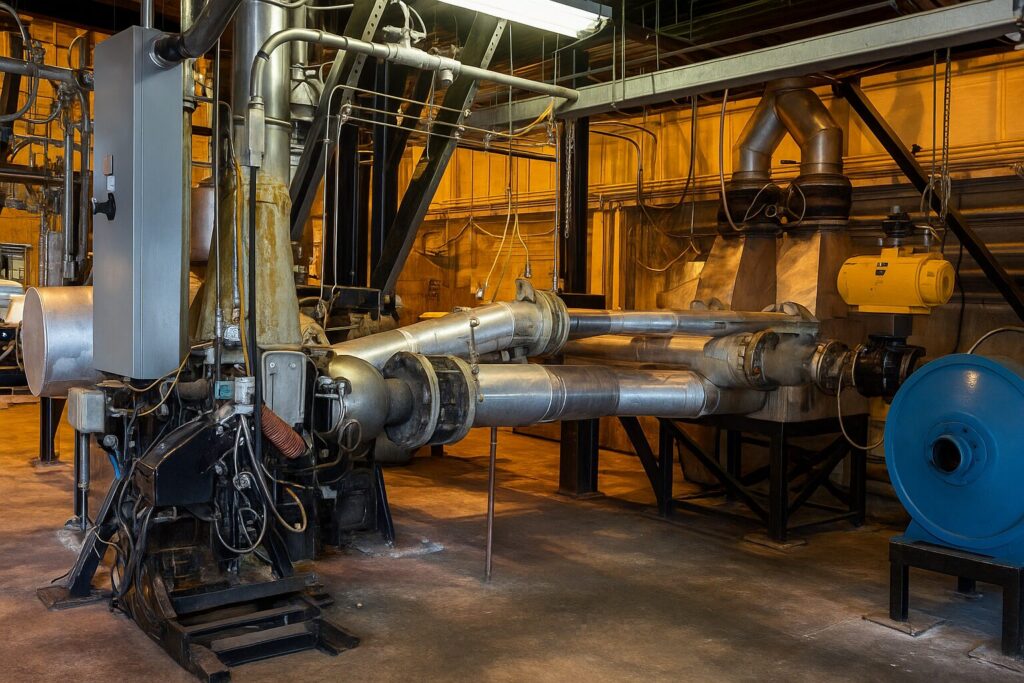
Standard cameras often break down on factory floors. A factory environment presents three deadly challenges that consumer electronics simply cannot survive.
| Pain Point | Challenge | AE430 3D Camera Solution |
|---|---|---|
| Physical Degradation | Consumer cameras break down quickly due to industrial dust, water spray, and physical impacts. | The ruggedized, IP67-rated casing provides complete protection against dust ingress and powerful water jets, ensuring reliable, long-term operation. |
| Thermal Failure | Robotic cameras overheat during continuous, high-speed operation in hot environments, leading to performance throttling or failure. | A built-in industrial heatsink efficiently dissipates heat, maintaining stable, uninterrupted performance even in high-temperature factory settings. |
| Cable Management | Standard USB connections are fragile and prone to disconnection, especially on a moving robot arm, leading to communication failure. | The AE430 utilizes Gigabit Ethernet (GigE) with Power over Ethernet (PoE) and M12 locked-cable connectors. This provides a secure, single-cable solution for power and high-speed data that withstands the twists and turns of a robotic arm. |
2. Weight and Space Constraints on Robotic Arms with Cameras
How Do Weight Constraints Limit Robot Arm Performance with Cameras?
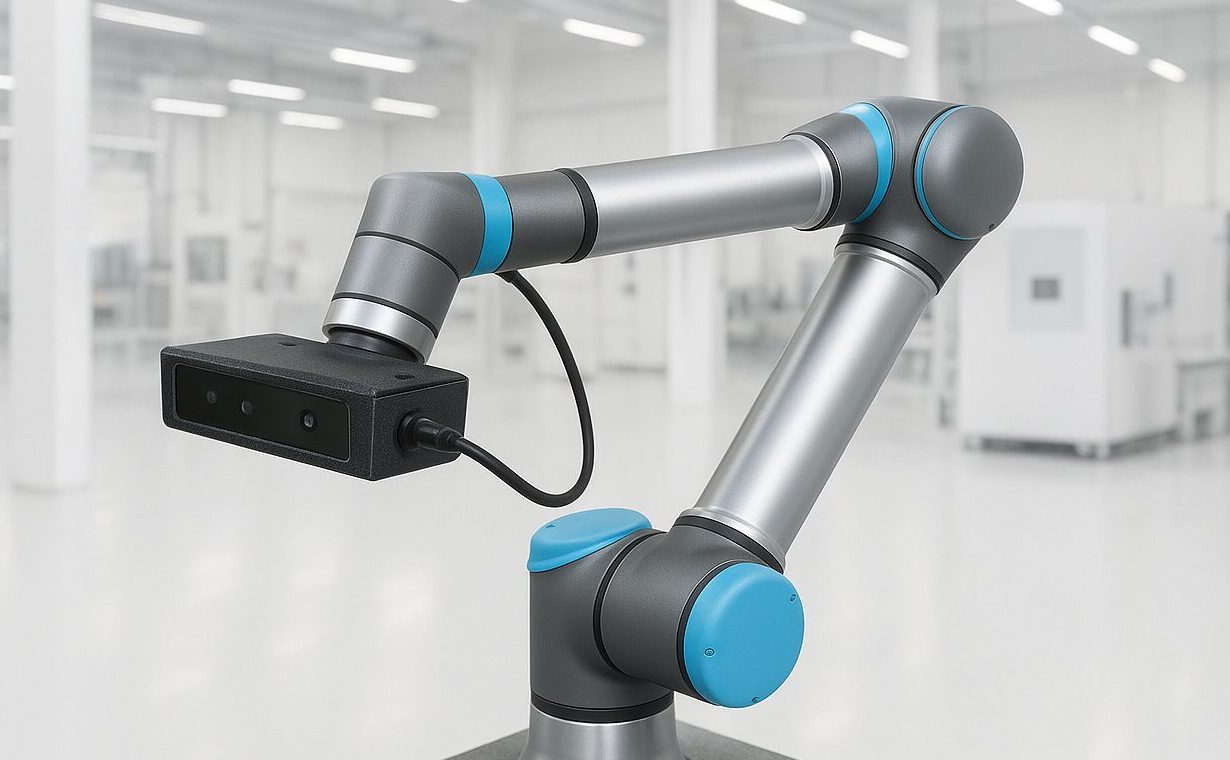
Camera weight matters so much for robotic arms. Every gram added to a robot arm with camera directly reduces speed, precision, and payload capacity, especially in hand-eye applications where the camera sits at the end-effector.
| Pain Point | Challenge | AE430 3D Camera Solution |
|---|---|---|
| Payload and Speed Limits | Heavy or bulky robot arm cameras limit the robot’s speed, range of motion, and effective payload capacity. | The AE430 is ultra-compact (118 x 32 x 60mm) and lightweight (approx. 280g). This small form factor minimizes payload impact, allowing the robot arm to move faster and maximize its effective working capacity. |
3. Data Quality and Environmental Noise in Machine Vision Cameras
What Causes Inaccurate 3D Data in Challenging Industrial Materials?
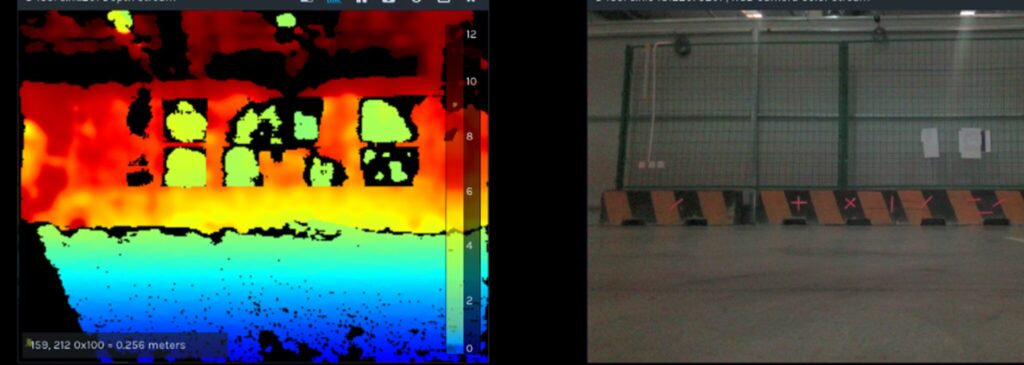
Reflective surfaces destroy depth sensing accuracy. Achieving consistent, accurate 3D data is difficult when dealing with the metallic, shiny, and high-contrast surfaces common in industrial applications.
| Pain Point | Challenge | AE430 3D Camera Solution |
|---|---|---|
| Reflective Surfaces & Noise | Reflective, shiny (metallic), or high-contrast surfaces (common in bin picking) cause inaccurate depth data and poor object detection in machine vision cameras. | As an Active Stereo camera, the AE430 projects its own light pattern to overcome ambient light and material challenges, providing enhanced, low-noise depth images and high Z-accuracy (≤ 2% @ 2m) for precision on difficult surfaces. |
| Localization Errors | Robots often lose track of their position. Accurate localization and path planning are difficult when the robot is moving or when the industrial camera is subject to vibration. | The built-in 6-axis Inertial Measurement Unit (IMU) provides real-time data on the camera’s acceleration and rotation, dramatically improving Vision-Guided Robotics (VGR) tasks like position estimation and motion control. |
4. System Integration and Latency Issues with Industrial Vision Cameras
What Causes Unacceptable Delays in Industrial Vision Systems?
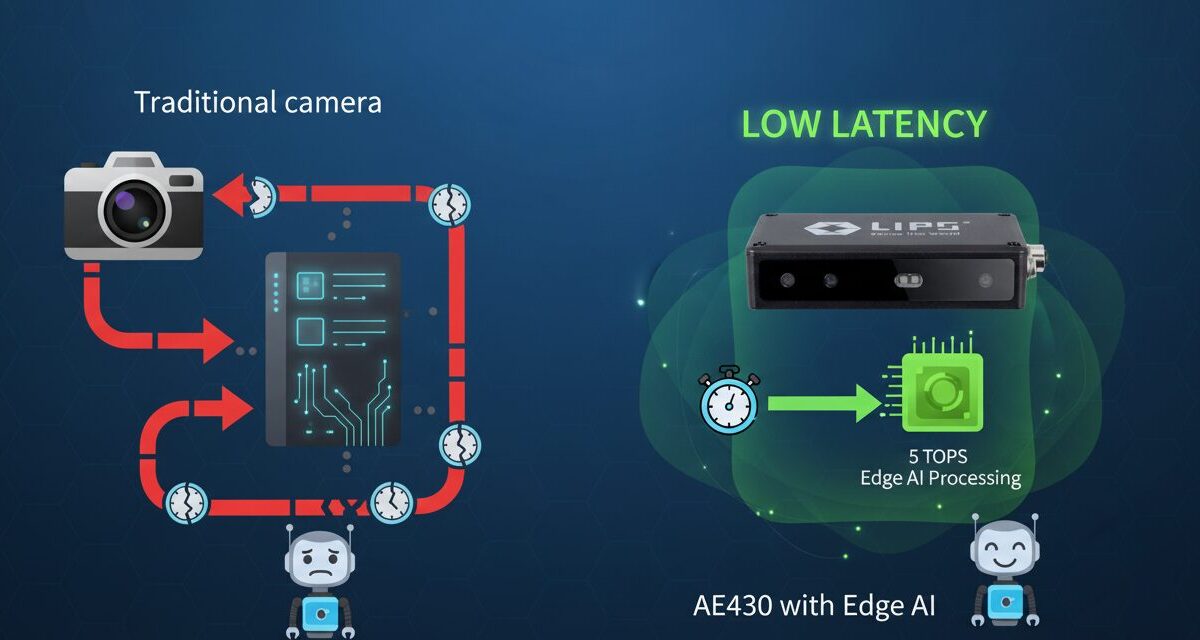
Most robotic vision systems suffer from integration nightmares. Integrating 3D vision cameras often introduces unacceptable processing delays (latency) and compatibility issues that make real-time robotics nearly impossible.
| Pain Point | Challenge | AE430 3D Camera Solution |
|---|---|---|
| High Latency | All image processing must be sent back to a centralized PC, creating communication latency and system overhead. | It includes an Edge AI System-on-a-Chip (SOC), capable of running Neural Network applications at 5.0 TOPS. This enables on-device processing (Edge Computing), reducing latency for critical tasks like real-time extraction and collision avoidance. |
| Integration Complexity | Compatibility with different robot and machine vision software frameworks is a major development hurdle. | The AE430 is highly compatible with industrial standards and robotics frameworks, including NVIDIA Isaac, ROS/ROS2, OpenCV, OpenNI, and HALCON, simplifying the development and deployment process for integrators. |
Conclusion
Which Industrial Camera Solution Eliminates 4 Critical Failures?
You can now avoid the failure rate in industrial vision deployments by implementing the LIPSedge AE430 industrial depth camera. The evolution of factory automation demands 3D vision systems that are not just accurate, but also resilient, fast, and easy to deploy. By resolving the core issues of durability, size, data integrity, and latency, the LIPSedge AE430 provides the complete solution that most engineers spend months trying to piece together from multiple vendors, and the foundation needed for robust, high-speed Vision-Guided Robotics (VGR),finally pushes the industry past the limitations of traditional 3D sensing.
Want to see how proper industrial camera selection transforms your automation success rate? Contact LIPS at [email protected] for a consultation and demo tailored to your specific automation deployment challenges.
——————————————————–
Frequently Asked Questions for Industrial Cameras
Q: What specifications/features make an industrial camera suitable for robot arms?
Industrial cameras for robot arms need to be lightweight (under 300g), compact, and ruggedized with IP67 rating such as LIPSedge AE430. They must handle vibration, temperature extremes, and continuous operation while maintaining secure connections through locked cables like M12 connectors.
Q: How do I choose between 2D and 3D cameras for robotics applications?
3D cameras like LIPSedge AE430 are essential for applications requiring depth perception like bin picking, object manipulation, and collision avoidance. Machine vision cameras with stereo capabilities provide spatial awareness that 2D cameras cannot match, making them ideal for complex robotic tasks.
Q: What causes latency issues in robotic cameras and how can they be solved?
Latency typically occurs when cameras for robotics send all processing to external computers. LIPSedge AE430 industrial 3D cameras with built-in Edge AI processing, like those with 5.0 TOPS capability, perform on-device computation to dramatically reduce response times for real-time robotic control.