
Table of Contents
ToggleManufacturing lines are grinding to a halt. Warehouses can’t find workers. Healthcare facilities are drowning in repetitive tasks. Across industries, the gap between automation needs and traditional robotic capabilities has never been resolved. Rising labor costs, increasing product variation, and pressure for faster delivery are pushing industries to rethink the limitations of conventional robotic automation.
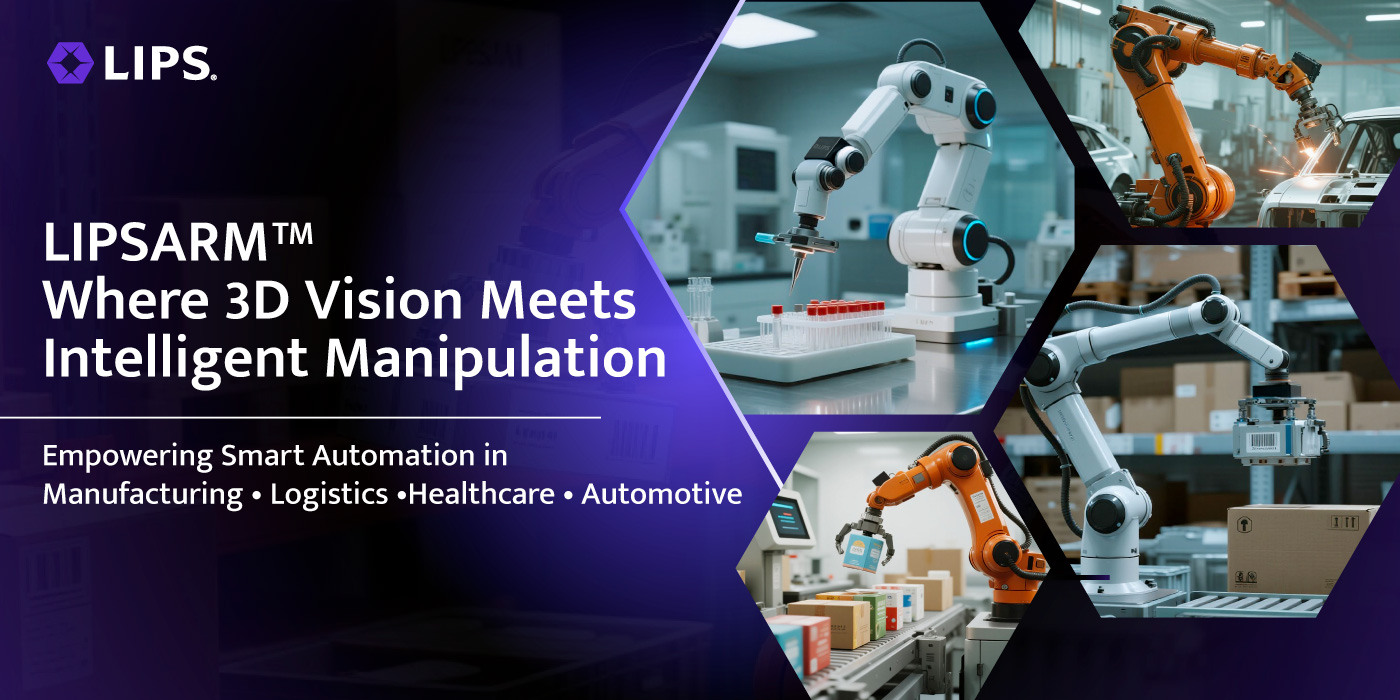
What if your robotic arm could see, think, and adapt in real-time like a human worker? LIPSARM™ Manipulator Devkit delivers exactly that – a next-generation robotic arm control system combining AI-powered 3D vision (vision-guided robotics), NVIDIA Isaac Manipulator, and real-time motion planning to deliver smarter, faster, and safer automation, and to transform how industries achieve robotic arm ROI.
Let’s explore five key industries where LIPSARM™ is reshaping how robots work – and why it’s becoming the go-to solution for companies aiming for high ROI and scalability.
1. Manufacturing – Achieves Breakthrough Precision with Vision-Guided Robotics
How can factories balance mass customization demands with zero-defect requirements?
Manufacturing today faces an impossible challenge – delivering high-mix, low-volume production at speeds and precision levels that manual labor simply cannot match. Traditional robotic automation lacks the visual intelligence to adapt to component variations without costly reprogramming.
How LIPSARM™ Solves the challenge:
LIPSARM™ combines LIPSedge AE430 stereo camera with Isaac Manipulator motion planning to enable robotic arms to “see” and “think” in real time.
| Pain Point | Challenge | LIPSARM Solution |
|---|---|---|
| Component variation handling | Rigid robots require reprogramming for each product change, causing costly downtime | LIPSARM’s AI-driven 6D pose estimation detects and aligns components automatically with high accuracy |
| Collision risks in complex environments | Traditional systems can’t navigate dynamic production floors safely | Nvblox mapping creates real-time 3D environment models for obstacle avoidance |
| Slow cycle times | Fixed motion paths waste time with unnecessary movements | Isaac Manipulator motion planning optimizes every movement for maximum speed and efficiency |
Results manufacturers are seeing with 3D vision robotic arms: Manufacturers deploying vision-guided robots have reported 25-40% increases in line throughput and up to 60% fewer assembly defects (IFR,2024).
LIPSARM™ robotic arm control systems gives manufacturers an immediate competitive edge – not by replacing skilled workers, but by empowering them to focus on higher-value quality control and optimization tasks.
The LIPSedge AE430 stereo camera captures rich depth data that enables robotic arms to “see” component orientations, surface defects, and spatial relationships in real-time. This level of visual intelligence transforms rigid automation into adaptive industrial automation that responds to production realities.
2. Warehousing & Logistics – Operations Cut Costs by 35% Through Intelligent Robotic Automation
Why are logistics centers still struggling with manual picking when robotic solutions exist?
The global warehousing industry is under immense pressure – labor shortages, rising wages, and unpredictable demand spikes. Most logistics centers still rely on manual picking, packing, and sorting because traditional robotic automation can’t handle the SKU variety and clutter found in real warehouse environments.
How LIPSARM™ solve the warehouse automation challenge:
The LIPSARM™ Devkit integrates with Warehouse Management Systems (WMS) and supports vision-based automation to handle items of all sizes, shapes, and packaging types.
| Pain Point | Challenge | LIPSARM™ Solution |
|---|---|---|
| Cluttered bin picking | Traditional robots fail when items overlap or vary in orientation | 3D vision robotics recognizes individual items in cluttered bins with 95%+ accuracy |
| Collision during high-speed operations | Fast-moving robots risk damaging inventory and infrastructure | Motion control algorithms plan precise picking and placement paths without collision |
| Isolated automation islands | Pick-and-place robots don’t communicate with mobile systems | Works seamlessly with autonomous mobile robots (LIPSAMR™) for end-to-end smart warehousing |
The real-world impact on warehouse ROI:
According to McKinsey, robotic arms can cut operational costs by 20-35% and order cycle times by up to 30%. With LIPSARM™, warehouses can achieve human-level adaptability with machine-level consistency – making fulfillment faster, more reliable and significantly more profitable.
The system’s ability to handle “random bin picking” – one of robotics’ most challenging tasks – comes from combining stereo depth perception with AI-powered object recognition. This vision-guided robotics approach eliminates the need for structured storage systems, dramatically reducing facility modification costs.
3. Healthcare & Life Sciences – Ensure Patient Safety and Accuracy Demands with Precision Robotics
Why haven’t hospitals and labs adopted robotic automation at scale?
In healthcare environments, automation errors aren’t just costly – they’re potentially life-threatening. Whether handling diagnostic samples in a lab or assisting in surgical procedures, precision and contamination control are critical. However, traditional robotic automation systems lack the visual intelligence to adapt in real time to delicate, unpredictable medical environments.
How 3D vision robotics address healthcare’s unique safety requirements:
LIPSARM™ brings depth-aware precision and AI vision specifically designed for medical and laboratory settings.
| Pain Point | Challenge | LIPSARM Solution |
|---|---|---|
| Sterile field contamination | Robots must navigate without touching unintended surfaces | Real-time 3D sensing maps sterile workspaces and maintains safe clearances |
| Sub-millimeter positioning requirements | Medical instruments and samples require precision beyond human capability | Foundation pose tracking ensures sub-millimeter accuracy for tool and sample positioning |
| Compliance and validation complexity | Medical devices require extensive testing before clinical deployment | Isaac SIM integration allows complete simulation of complex movements before deployment |
Healthcare’s driving shift toward robotic arm control systems:
The medical robotics market is expected to grow from $16.6 B (2023) to $63.8 B (2032) at a 16.19% CAGR (SNS Insider,2025). This explosive growth reflects healthcare’s urgent need for automation that’s both safe and intelligent.
LIPSARM™ is positioned perfectly for this growth – offering healthcare facilities industrial automation technology adapted for medical-grade reliability. The system’s ability to simulate procedures virtually before deployment dramatically reduces validation time and regulatory compliance costs, addressing one of healthcare’s biggest barriers to robotic adoption.
4. Retail & Consumer Goods – Operations Adapt to New SKUs in Minutes Instead of Days
Why do retailers struggle to automate when products change constantly?
Retail and consumer goods sectors are fast-moving – products, packaging, and SKU configurations change weekly or even daily Reprogramming traditional robots every time a new product launches is costly and time-consuming, often requiring specialized robotics engineers and production downtime.
How LIPSARM robotic arm control systems eliminate reprogramming bottlenecks:
LIPSARM™ adapts dynamically to new SKUs and packaging variations without retraining or heavy reprogramming.
| Pain Point | Challenge | LIPSARM Solution |
|---|---|---|
| New product introduction delays | Traditional robots need days of reprogramming for each SKU change | Vision-based recognition identifies different shapes, sizes, and materials instantly without training |
| Packaging variation handling | Seasonal packaging or promotional designs break automation workflows | AI motion control adjusts grip force, speed, and approach angle in real-time based on visual assessment |
| Testing and validation time | Physical testing of new configurations risks inventory damage | Isaac SIM support enables virtual testing — new product setups validated before hitting the production floor |
The impact on retail automation ROI is substantial:
The ability to introduce new products without automation downtime transforms the economics of robotic arm control systems for retail. Vision-guided robotics eliminates the “automation tax” that previously made robotic solutions impractical for high-variety retail environments.
Retailers using 3D vision robotic arms report setup times reduced from days to minutes, enabling automation in environments previously considered too dynamic for robotics. This flexibility extends robotic automation benefits to small and medium-sized operations that couldn’t justify traditional systems.
5. Automotive – Manufacturing Combines Precision with Human-Robot Collaboration Safety
Why are automotive manufacturers replacing recently installed robotic systems?
In automotive assembly lines, precision, repeatability, and safety are non-negotiable requirements.
Yet, conventional robots struggle to adapt to frequent model changes , can’t work safely around humans and lack the visual feedback needed for quality verification during assembly.
How LIPSARM enable the next generation of automotive automation:
LIPSARM™ enhances robotic precision and flexibility through 3D stereo vision and adaptive AI motion planning specifically designed for automotive requirements.
| Pain Point | Challenge | LIPSARM Solution |
|---|---|---|
| Model changeover downtime | Traditional robots require extensive reprogramming for new vehicle models | Real-time visual feedback enables robots to locate bolts, welds, and parts regardless of model variation |
| Human-robot safety zones | Conventional safety systems require large exclusion zones that waste floor space | Dynamic obstacle detection prevents collisions while allowing humans and robots to work in shared spaces |
| Quality verification delays | Separate inspection steps slow production and catch defects late | Vision-guided robotics performs real-time quality verification during assembly operations |
Processing power enables real-time automotive automation:
LIPSARM™ is compatible with RTX 4080 and Jetson Orin platforms for heavy on-device AI processing, eliminating network latency that would compromise safety and precision. This edge computing architecture ensures microsecond response times essential for automotive applications. The system helps automakers shift from rigid automation to adaptive intelligence – where robotic arm control systems collaborate safely with people on the line. This collaborative approach preserves human expertise for complex tasks while leveraging robotic precision for repetitive operations, delivering optimal robotic arm ROI.
LIPSARM Robotic Arm Control Systems Deliver Clear Competitive Advantages
LIPSARM is different from traditional industrial automation platforms. While conventional robotic systems require extensive integration work and specialized programming, LIPSARM™ delivers a complete vision-guided robotics solution:
- AI-Powered 3D Vision Robotics: LIPSedge AE430 captures rich depth data with accurate precision – even in challenging lighting conditions that defeat traditional vision systems.
- NVIDIA Isaac Integration: Full compatibility with Isaac Manipulator, Nvblox, and FoundationPose accelerates development and deployment, reducing time-to-production compared to custom integration approaches.
- Turnkey Development Kit: Bundles 3D depth camera, compute module, and software – dramatically reducing integration time and cutting initial costs.
- Simulation-Ready Validation: Isaac SIM and OmniScan support virtual testing before real-world deployment, eliminating costly physical prototyping and reducing risk.
- Cross-Industry Adaptability: From factories to hospitals, the same core platform scales effortlessly across workflows with industry-specific configuration rather than custom development.
Vision-Guided Robotics are the Future of Industrial Automation
How can companies ensure their automation investments remain competitive?
In a world where robots need to see, think, and act intelligently – LIPSARM™ is leading the transformation from rigid automation to adaptive intelligence.
By combining AI perception, motion intelligence, and hardware optimization, LIPSARM™ bridges the gap between traditional robotic automation and the next generation of smart robotics. Companies implementing vision-guided robotics today are building competitive advantages that compound over time as AI capabilities continue advancing.
Ready to experience how vision-guided robotics automation can redefine your operational ROI? Contact our industrial automation team to discuss your specific application requirements and see LIPSARM™ robotic arm control systems in action.
References
- https://www.mckinsey.com/capabilities/operations/our-insights/getting-warehouse-automation-right
- https://www.snsinsider.com/reports/medical-robotics-market-5580
- https://ifr.org/img/worldrobotics/Press_Conference_2024.pdf
———————————————–
Frequently Asked Questions for Robot Control System
Q: What industries benefit most from robotic arm control systems?
Manufacturing, warehousing, healthcare, retail, and automotive sectors see the highest ROI from LIPSARM vision-guided robotics systems. Any industry requiring precision handling of varied objects in dynamic environments benefits from 3D vision robotic arms.
Q: How does LIPSARM improve robotic arm ROI compared to traditional automation?
LIPSARM robot control system increases manufacturing throughput by 25-40% and reduces assembly defects by up to 60%. In warehousing, it cuts operational costs by 20-35% and order cycle times by up to 30%, delivering superior ROI compared to traditional robotic automation systems.
Q: What makes vision-guided robotics more adaptable than traditional systems?
Vision-guided robotics uses real-time 3D perception to understand object positions, orientations, and environmental conditions, enabling robots to handle variations without reprogramming – unlike traditional systems that follow fixed paths.
Related posts:
- LIPSedge™ S315 Slim Active Stereo Edge-AI Depth Camera for Next-Generation Robotic Vision
- LIPSMetric™ Parcel Dimensioning: Key to Sustainable Logistics Success
- 5 Key 3D Camera Trends Transforming Robotics and Factory Automation
- How LIPSedge 3D Depth Camera Technology is Driving Key Industry Trends in Machine Vision