
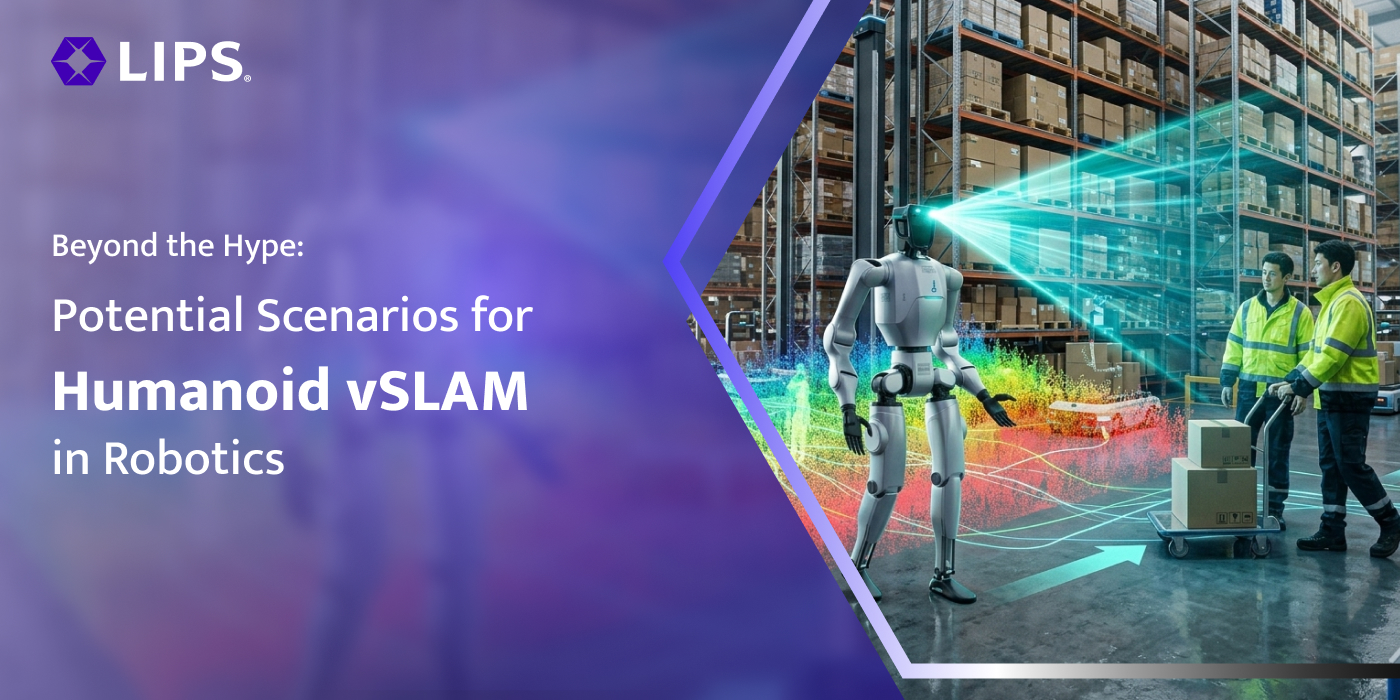
In the rapidly evolving landscape of autonomous systems, Visual Simultaneous Localization and Mapping (vSLAM) stands as a cornerstone technology, enabling autonomous robots to understand and navigate their environments. While traditional vSLAM has powered various robotic applications, the emergence of Humanoid vSLAM marks a significant leap forward, particularly for robots operating in complex, human-centric spaces. This advanced paradigm is not just a technical enhancement; it’s a strategic imperative for engineers looking to deploy truly intelligent and adaptable robotic solutions. The ability for robots to seamlessly and safely coexist with humans in dynamic environments is no longer a futuristic vision but an imminent reality, driven by innovations like the LIPSAMR’s Perception Dev Kit.
The Evolution of vSLAM: From Static Maps to Dynamic Human Environments
vSLAM, at its core, allows a robot to simultaneously build a map of its surroundings and localize itself within that map using visual input. This fundamental capability has been instrumental in the development of autonomous navigation. However, as robotics ventures into more collaborative and service-oriented roles, the limitations of conventional vSLAM in highly dynamic, human-populated spaces become apparent. Traditional vSLAM often struggles with:
- Dynamic Occlusions: Humans and moving objects frequently block a robot’s view, leading to temporary loss of localization or mapping errors.
- Semantic Ambiguity: Differentiating between a static wall and a human, or understanding the intent behind human movement, is crucial for safe interaction but challenging for basic vSLAM.
- Environmental Variability: Lighting changes, reflective surfaces, and repetitive textures common in human environments can degrade the performance of purely visual systems.
Humanoid vSLAM extends this capability by specifically optimizing environments where human presence and interaction are common. It is engineered with advanced algorithms and sensor fusion techniques to interpret and adapt to the nuances of human activity, making it indispensable for collaborative and service robotics. This specialized form of vSLAM addresses critical challenges by:
- Intelligent Dynamic Obstacle Avoidance: Moving beyond simple collision detection, Humanoid vSLAM can distinguish between static infrastructure and moving humans or objects, predict their trajectories, and plan evasive maneuvers that are both efficient and safe. This predictive capability is vital for preventing abrupt stops or erratic movements that could disrupt human workflows or cause accidents.
- Enhanced Contextual Awareness: By integrating semantic understanding, Humanoid vSLAM can interpret human intent through gestures, proximity, and even gaze direction. This enables more natural, intuitive, and safer interactions, allowing autonomous robots to anticipate human actions and respond appropriately, fostering trust and efficiency in shared workspaces.
- Unprecedented Robustness in Varied Conditions: Through sophisticated sensor fusion and advanced perception algorithms, Humanoid vSLAM maintains localization and mapping accuracy even in environments with rapidly changing lighting, significant occlusions, or highly textured/textureless scenes. This resilience ensures continuous operation and reliability, a key concern for industrial deployments.
LIPSAMR’s Pioneering Role in Humanoid vSLAM: A Technical Deep Dive into the Perception Dev Kit
LIPSAMR is at the forefront of this revolution, offering a Perception Dev Kit that embodies the pinnacle of Humanoid vSLAM technology. Our solution leverages advanced spatial and inertial fusion to deliver unparalleled accuracy and adaptability. By integrating high-resolution RGB-D camera data with Inertial Measurement Unit (IMU) inputs, LIPSAMR creates a dense 3D map with precise spatial structure and robust pose tracking. This fusion is critical for overcoming the inherent limitations of single-sensor systems, ensuring stable navigation even in challenging scenarios where visual features might be sparse or lighting conditions suboptimal.
Core Technical Enablers of LIPSAMR’s Humanoid vSLAM:
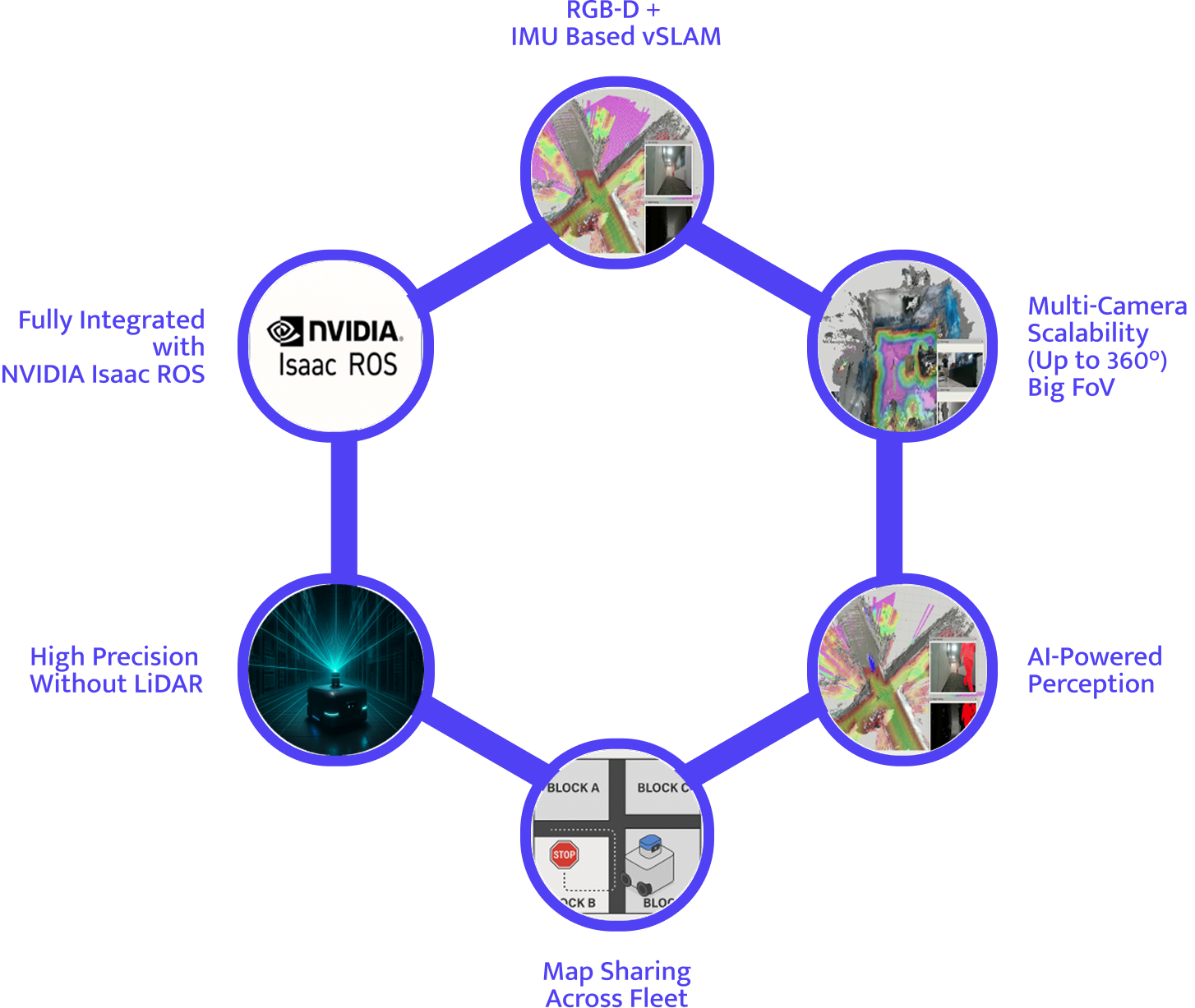
- Multi-Camera Scalability for Comprehensive Perception: LIPSAMR supports multi-node camera configurations, allowing for the elimination of blind spots and the achievement of up to a 360-degree comprehensive Field-of-View (FOV). This is crucial for complete environmental awareness, especially in crowded or confined spaces where humans and other dynamic elements are present. The ability to integrate data from multiple perspectives provides a richer, more redundant dataset for robust perception.
- Advanced Sensor Fusion Architecture: At the heart of LIPSAMR lies a robust fusion framework that seamlessly integrates visual odometry from multiple perspective nodes with IMU data. This sophisticated sensor fusion significantly enhances vSLAM stability and localization resilience in dynamic or feature-poor zones. The IMU provides high-frequency motion data, compensating for visual ambiguities and providing a stable reference frame, while the visual data offers precise positional updates, leading to a highly accurate and drift-resistant localization solution.
- Dynamic Relocalization for Uninterrupted Operation: Leveraging a high-density visual feature database, LIPSAMR autonomously restores pose estimation and spatial orientation following tracking failure or manual displacement. This capability is paramount in real-world settings where robots might be manually moved, experience temporary sensor outages, or encounter unexpected environmental changes. Dynamic relocalization ensures continuous operation and eliminates the need for manual recalibration or returning to a known home station, a critical feature for maintaining productivity and operational efficiency.
Potential Scenarios: Where Humanoid vSLAM with LIPSAMR Will Transform Operations
While technology is rapidly maturing, the potential applications of Humanoid vSLAM, powered by LIPSAMR, are poised to revolutionize numerous sectors. These scenarios highlight how LIPSAMR’s capabilities address critical industry needs:
Scenario 1: Collaborative Logistics in Next-Generation Warehouses
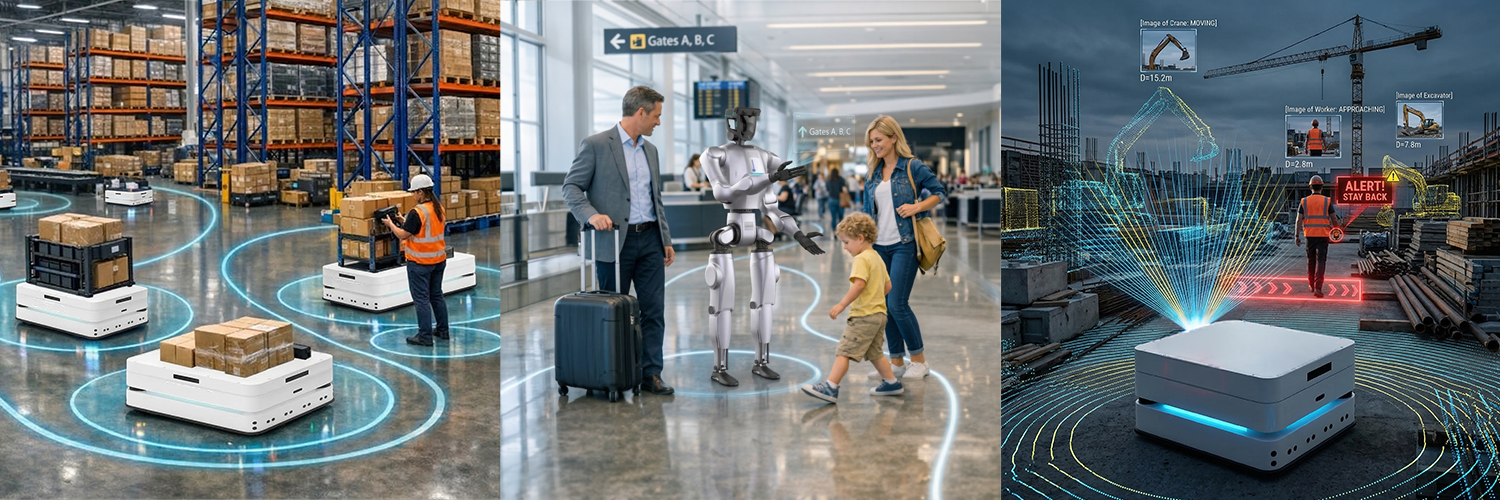
Imagine a large-scale fulfillment center where AMRs and human workers seamlessly share aisles and workstations. LIPSAMR-equipped AMRs could:
- Navigate Crowded Aisles: Intelligently detect and predict the movement of human pickers, forklifts, and other AMRs, dynamically adjusting their paths to avoid collisions and maintain optimal flow. This goes beyond simple
collision avoidance by understanding human intent and adapting behavior. - Dynamic Task Allocation: In situations where a human worker needs to access a specific shelf, an AMR could temporarily reroute or pause, ensuring the human has unimpeded access, and then resume its task once the path is clear. This requires a deep understanding of the environment and the ability to make real-time decisions based on human activity.
- Enhanced Safety Protocols: By continuously monitoring the environment with its multi-camera setup and advanced vSLAM, LIPSAMR can create dynamic safety zones around human workers, triggering alerts or initiating safe stops if a human enters a restricted area unexpectedly. This proactive safety measure is crucial for preventing accidents in fast-paced environments.
Scenario 2: Autonomous Service Robots in Public and Commercial Spaces
Consider service robots deployed in airports, shopping malls, or large corporate campuses. These environments are characterized by unpredictable human movement, varying lighting conditions, and a constant influx of new obstacles. LIPSAMR-powered robots could:
- Intelligent Crowd Navigation: Move smoothly through dense crowds, anticipating pedestrian flow and finding optimal paths without causing disruption or discomfort. This involves not just avoiding individuals but understanding collective movement patterns.
- Personalized Interaction and Guidance: A service robot could guide a visitor to a specific location, maintaining a safe and comfortable distance, and adapting its speed and trajectory based on the visitor’s pace and any sudden changes in direction. Humanoid vSLAM enables the robot to perceive and respond to these subtle human cues.
- Adaptive Cleaning and Maintenance: Cleaning robots equipped with LIPSAMR could dynamically adjust their routes to avoid active areas during peak hours, focusing on less trafficked zones, and then returning to complete the full area during off-peak times. They could also detect and avoid temporary obstacles like luggage or spills, ensuring efficient operation without human intervention.
Scenario 3: Human-Robot Collaboration in Advanced Manufacturing
In modern manufacturing, the integration of robots into human workflows is increasing. LIPSAMR can facilitate this collaboration in complex assembly or inspection tasks:
- Shared Workspace Safety: A collaborative robot (cobot) equipped with LIPSAMR could share a workspace with a human technician, performing delicate assembly tasks. If the human reaches into the robot’s operational zone, the LIPSAMR system would immediately detect the human’s presence and intent, slowing down or pausing its operation to prevent any potential contact, and resuming only when the human has safely withdrawn.
- Dynamic Tool Handover: In a scenario requiring tool exchange, the robot could precisely track the human’s hand movements, accurately presenting the correct tool at the optimal orientation and time, enhancing efficiency and reducing the risk of errors.
- Adaptive Inspection and Quality Control: An AMR carrying an inspection camera could navigate around a large, complex machine while a human operator performs maintenance. The LIPSAMR system would ensure the AMR maintains a safe distance, avoids interfering with the human’s work, and can even adapt its inspection path based on real-time feedback from the human or detected anomalies.
Scenario 4: Autonomous Construction Site Monitoring and Support
Construction sites are notoriously dynamic, unstructured, and hazardous environments. LIPSAMR-enabled AMRs could significantly enhance safety and efficiency:
- Real-time Hazard Detection: An AMR could continuously scan the construction site, identifying moving vehicles, personnel, and changing terrain. LIPSAMR’s dynamic obstacle avoidance and 3D mapping capabilities would allow it to flag potential hazards and communicate them to human supervisors or other autonomous equipment.
- Progress Monitoring and Material Delivery: Robots could autonomously navigate complex, evolving construction layouts to monitor progress, collect data, or deliver materials to specific locations. The Humanoid vSLAM would enable them to adapt to new obstacles and safely operate alongside human workers.
- Safety Compliance and Zone Management: LIPSAMR could be used to enforce dynamic safety zones, ensuring that personnel and equipment remain within designated areas and alerting operators to breaches. This is particularly valuable in areas with heavy machinery or ongoing hazardous operations.
The LIPSAMR Advantage: A Strategic Choice for Future-Proof Robotics
For System Integrators, the LIPSAMR Perception Dev Kit provides a robust, pre-validated perception stack that significantly accelerates development cycles and reduces integration complexities. The modular architecture and ROS 2 compatibility ensure seamless integration into existing and future robotic platforms. This means faster deployment, lower development costs, and a higher probability of project success.
Distributors gain a highly differentiated product with clear technical advantages and broad market appeal. LIPSAMR addresses a critical need for advanced, reliable, and safe navigation in human-centric environments, opening up new market segments and revenue streams. The partnership with NVIDIA Isaac Perceptor further enhances its market position, offering a solution built on industry-leading AI hardware and software.
Product Managers can leverage LIPSAMR to build next-generation AMRs and autonomous robots that are not only more intelligent and capable but also inherently safer and more adaptable. This translates into products with a stronger competitive edge, higher customer satisfaction, and ultimately, greater market penetration and return on investment. The ability to offer solutions that can truly operate with humans, rather than merely around them, is a powerful differentiator.
Conclusion: The Dawn of Truly Collaborative Robotics
Humanoid vSLAM is not merely an incremental improvement; it’s a foundational technology for the next era of robotics. By enabling robots to perceive, understand, and safely interact within human environments, it unlocks new possibilities for automation across industries. The LIPSAMR’s Perception Dev Kit, with its advanced spatial and inertial fusion, multi-camera scalability, dynamic relocalization capabilities, and robust architecture, stands as the leading solution for developers, integrators, and businesses aiming to deploy intelligent, reliable, and truly collaborative robotic systems. Embrace the future of human-robot interaction with LIPSAMR, and transform your autonomous solutions into intelligent partners, ready to navigate the complexities of our shared world.
Frequently Asked Questions (FAQ)
Q1: What is Humanoid vSLAM, and why is it important for autonomous robots?
A: Humanoid vSLAM is an advanced form of visual navigation optimized for human-centric environments. Unlike traditional vSLAM, it provides dynamic obstacle avoidance and contextual awareness, allowing autonomous robots to safely understand human intent and coexist in complex workspaces without disrupting operations.
Q2: How does the LIPSAMR Perception Dev Kit improve robotic navigation?
A: The LIPSAMR Perception Dev Kit utilizes sophisticated sensor fusion, combining high-resolution RGB-D camera data with IMU inputs. This ensures highly accurate 3D mapping, dynamic relocalization, and stable navigation even in environments with poor lighting, repetitive textures, or frequent occlusions.
Q3: Which industries benefit the most from integrating LIPSAMR technology?
A: LIPSAMR is highly adaptable and provides strategic advantages for next-generation warehouse logistics, autonomous service robots in public spaces, collaborative advanced manufacturing, and dynamic construction site monitoring.